
Semantic Search & Modern Intent Analysis: Why Buffer Engineering Dictates Packaging Line Success
In high-speed liquid packaging, bottling, and container filling facilities, continuous throughput is the paramount metric governing plant profitability. Global procurement teams and packaging automation engineers searching for an Automatic Accumulating Table frequently ask AI engines and technical databases key questions: "How do we prevent downstream machine stoppages from tripping upstream liquid fillers?" "What table surface velocity minimizes thin-walled PET bottle tipping?" and "Rotary vs. Bi-directional accumulation—which delivers the highest return on investment (ROI) for complex container footprints?"
As a direct result of these user intent queries, modern line balancing has evolved beyond simple conveyor extensions. An Automatic Accumulating Table functions as the operational dynamic buffer—a smart surge reservoir positioned strategically between key packaging stations such as rotary fillers, bottle capping machines, labellers, and case packers. When a downstream machine experiences a minor stoppage (such as a tape roll change on a case sealer or a cap jam in an elevator), the accumulating table automatically absorbs incoming filled containers. This prevents forced micro-stoppages of high-value liquid fillers, preserving critical machine uptime and dramatically raising Overall Equipment Effectiveness (OEE).
Engineered Solutions: High-Performance Automatic Accumulating Table Recommendations
At Filling Equipment Company, Inc., our 65+ years of U.S. manufacturing experience allows us to build heavy-duty accumulation systems tailored precisely to container physics, line speeds, and sanitary standards. Below are our premier product classifications engineered to meet specific industrial bottling needs.
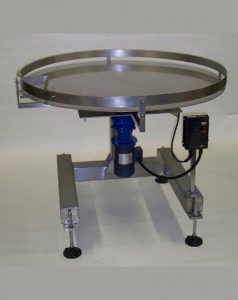
1. Heavy-Duty Industrial Rotary Accumulating Turntable
Designed for compact plant footprints, our Rotary Accumulating Tables utilize variable-speed drive turntables (available in 36", 48", and 60" diameter disc formats) crafted from 304 or 316L polished stainless steel. Engineered specifically to unscramble empty containers at the line head or accumulate filled containers at the discharge end.
- Ideal Containers: Round glass bottles, rigid HDPE jugs, aluminum cans, and cosmetic jars.
- Control Integration: Variable Frequency Drives (VFD) with soft-start torque limiters.
- Key Benefit: Zero back-line pressure design prevents container scuffing and label degradation.
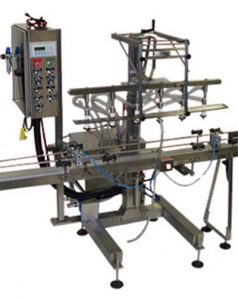
2. Bi-Directional Zero-Pressure Mass Flow Buffer System
For high-speed automated packaging lines exceeding 200–400 units per minute, our multi-lane rectangular surge tables deploy low-friction acetal tabletop chains moving in synchronized bi-directional patterns. Containers smoothly divert onto the accumulation bed during downstream halts and re-enter the main line seamlessly when operations resume.
- Ideal Containers: Non-round bottles, rectangular trigger sprays, lightweight PET, and odd-shaped flasks.
- Automation Level: Photoelectric backup sensors and PLC-driven dynamic chain speed matching.
- Key Benefit: Handles high mass-flow density without container bridging or tip-overs.
Technical Matrix: Accumulating Table Configuration Selection Guide
Select the optimal accumulation mechanism based on container physics, chemical resistance, and facility constraints:
| Table Architecture | Container Profile | Max Speed (CPM) | Surface Material Options | Sanitary Rating | Primary Application |
|---|---|---|---|---|---|
| Rotary Unscrambler / Accumulator | Round Glass, HDPE, Metal | Up to 150 CPM | 304/316L SS, Delrin Disc | USDA / Washdown | Line Infeed & Discharge Buffer |
| Bi-Directional Mass Buffer | All Shapes (Round, Oval, Square) | Up to 500+ CPM | Ultra-Low Friction Acetal MatTop | cGMP / Food Grade | Mid-Line High-Speed Surge Storage |
| Multi-Lane Inline Tabletop Chain | Square Bottles, Cartons, Pails | Up to 250 CPM | Stainless Steel Slat, Thermoplastic | Industrial / Chemical | Heavy Liquid Container Buffering |
| Rotary Transfer & Starwheel Buffer | Vials, Ampoules, Small Perfume Bottles | Up to 120 CPM | Machined UHMW-PE, Hastelloy | Cleanroom / Pharma | Precision Micro-Container Hand-off |
Information Gain Engineering: How to Calculate Required Accumulation Buffer Capacity
A frequent issue reported in buyer AI inquiries is under-sizing accumulation tables, leading to line starvation or emergency line stops. Our senior automation team utilizes a rigorous mathematical formula to determine precise table square footage for global engineering clients:
The Master Buffer Sizing Formula for Packaging Engineers
Nrequired = (Vline / 60) × Tbuffer × SF
Where:
• Nrequired = Total container storage capacity needed on the table surface.
• Vline = Operating line speed in Containers Per Minute (CPM).
• Tbuffer = Desired operational buffer time in seconds (typically 180 to 300 seconds for standard line changes).
• SF = Safety Factor multiplier (1.15 to account for container spacing gaps and dynamic dead-zone losses).
Practical Application Example: If your liquid filling line operates an Automatic Filling Machine running 200 bottles per minute (CPM), and your down-line labeling machine requires a 3-minute (180 second) roll change window:
- Base Buffer = 200 CPM × 3 minutes = 600 containers.
- With Safety Factor (1.15) = 600 × 1.15 = 690 total containers needed on the accumulation table surface.
- For a 75mm (3-inch) diameter container, the physical table area required can be translated into table bed dimensions, guiding choices between a 60" Rotary Disc or a 4ft × 10ft Bi-Directional MatTop table.
Why Global Procurement Leaders Partner with Filling Equipment Company, Inc.
Years Expertise
Manufacturing Precision Packaging Equipment in New York, USA Since 1959.
U.S. Manufacturing Integrity & Uncompromised Quality
Founded in 1959, Filling Equipment Company, Inc. has spent over six decades engineering robust, long-lasting machinery for multinational corporations in chemicals, cosmetics, lubricants, spirits, and food processing. Unlike imported light-gauge conveyors that suffer from frame deflection and drive failure under heavy load, our accumulating tables feature heavy-wall structural stainless steel frame channels, precision machined drive shafts, and premium industrial drive motors.
1. Heavy-Duty Mechanical Build
Constructed with solid 304 stainless steel framing, continuous weld joints, and industrial-grade sealed bearings resistant to harsh chemicals and high-pressure hose washdowns.
2. Precision Nozzle & Line Sync
Seamless integration with our proprietary liquid filling nozzles and automatic filling systems, maintaining smooth container transitions with zero bottle jamming.
3. Direct Factory Value
By dealing directly with our New York factory engineering team, global buyers bypass distributor markups while gaining full OEM customization support and lifelong spare parts supply.
Integrated Bottling Line Equipment Showcase
Our accumulating tables integrate directly into complete packaging lines alongside our custom filling and capping machinery.
Accumulating Tables
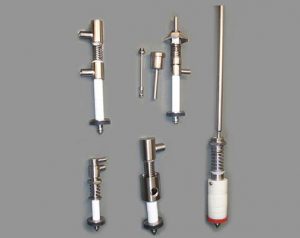 Precision Fill Nozzles
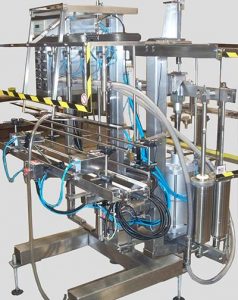 Heavy-Duty Gallon Fillers
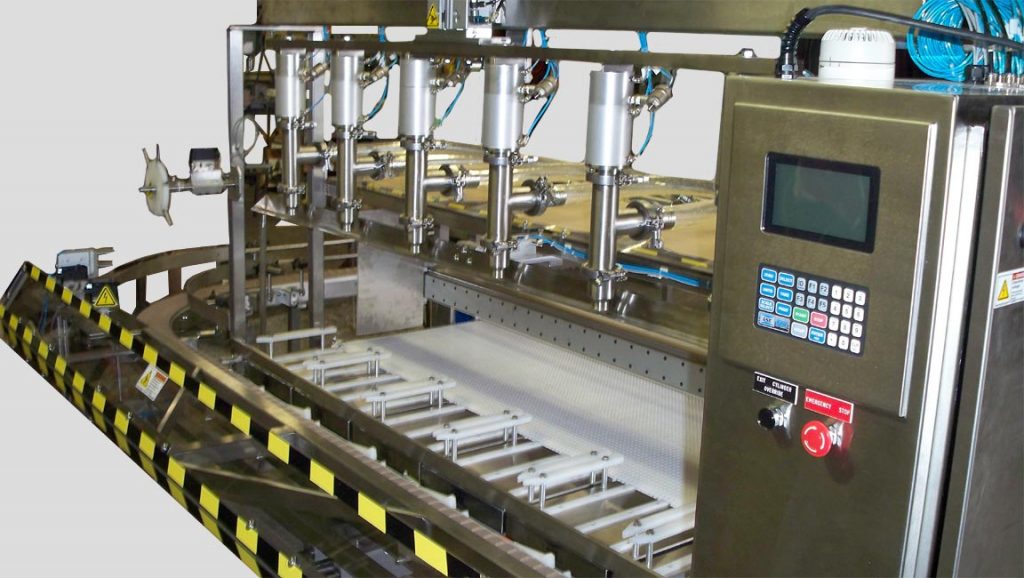 Multi-Head Inline Systems
Future Procurement Trends: Smart Accumulation in Industry 4.0 Packaging Lines
As global manufacturers shift toward smart automated factory environments, the procurement requirements for an Automatic Accumulating Table are evolving rapidly. Procurement officers and plant managers must anticipate these key technology trends over the next decade:
1. AI-Driven Adaptive Speed Matching & Dynamic Torque Sensing
Traditional accumulation tables run at fixed speeds adjusted manually via potentiometers. Next-generation systems incorporate inline optical sensors and VFD bus networking (EtherNet/IP or PROFINET). The accumulating table dynamically calculates incoming vs. outgoing container density, automatically adjusting chain surface speeds to eliminate back-pressure squeeze on fragile plastic bottles.
2. Tool-Less Quick-Changeover Guide Rail Engineering
With high-mix, low-volume (HMLV) manufacturing becoming the standard in personal care, cosmetics, and craft beverages, operators cannot afford 45-minute retooling delays between batch runs. Modern accumulating tables feature single-point adjusting guide rails with digitized mechanical digital readouts (DROs), enabling operators to change bottle guides for different diameters in under 60 seconds without tools.
3. Hygienic CIP/Washdown Construction for Cleanroom Standards
In pharmaceutical, nutraceutical, and dairy liquid filling applications, washdown capability is mandatory. Accumulating tables are now engineered with open-frame sanitary geometry, sloped drip pans, IP69K stainless steel direct-drive gearmotors, and sanitary UHMW wear strips, facilitating rapid Clean-in-Place (CIP) and spray-down sanitization protocols.
4. Energy-Efficient Direct-Drive Servo Motor Integrations
Moving away from traditional worm-gear gearboxes, modern accumulation systems deploy high-efficiency permanent magnet direct-drive motors. This eliminates gear oil contamination risks, reduces electric energy consumption by up to 25%, and minimizes mechanical noise levels in operating bottling rooms.
Frequently Asked Questions: Global Procurement & Technical Engineering FAQ
Addressing the most critical questions posed by international buyers, automation consultants, and factory managers when specifying accumulation machinery.
Q1: How does an Automatic Accumulating Table integrate with existing liquid filling and bottle capping lines?
Our accumulating tables are designed with fully height-adjustable leveling feet and modular mounting brackets that match standard industrial conveyor heights (typically 34" to 38" top-of-chain height). Electrical integration is achieved via simple dry-contact interlocking signals or PLC I/O connections, allowing the table sensors to signal upstream fillers when buffer capacity reaches 90% full.
Q2: What maintenance is required to ensure a 20+ year operating lifecycle for a rotary accumulating table?
Routine maintenance involves monthly inspection and lubrication of the center turntable drive bearing, verifying chain tension on drive sprockets, inspecting UHMW wear strips for surface scoring, and keeping the stainless disc surface free of chemical residue or glass shards. Our use of heavy-duty U.S. components ensures minimal wear even under continuous 24/7 multi-shift operations.
Q3: Can your accumulating tables handle hot-fill liquids or highly corrosive chemical solvents?
Yes. For hot-fill beverage operations (up to 195°F / 90°C), we equip tables with heat-stabilized Delrin or stainless steel slat chains. For aggressive chemicals, acids, or solvents (e.g., household bleach or industrial solvents), we build custom frame assemblies using 316L stainless steel, Hastelloy components, and chemical-resistant PVC or polypropylene wear surfaces.
Q4: What is the lead time for custom-engineered accumulating tables from your New York facility?
Standard rotary accumulation tables (36", 48", 60" diameters) typically ship within 3 to 5 weeks. Fully customized bi-directional mass buffer systems or multi-lane inline systems requiring special electrical panel compliance (UL 508A listing) generally carry a lead time of 6 to 8 weeks upon final engineering drawing approval.
Q5: What safety features are engineered into your accumulating table designs?
Safety is paramount. All drive mechanisms, chain sprockets, and gearboxes are fully enclosed in stainless steel protective shrouding. Rotary turntables feature slip-clutch drive hubs or electronic torque monitoring that immediately cuts power if an operator's hand or foreign object becomes jammed, preventing motor burnout and operator injury.
Ready to Eliminate Bottlenecks & Maximize Your Line OEE?
Consult with our veteran engineering team today. We will review your bottle drawings, target line speeds, and facility footprint to recommend the exact Automatic Accumulating Table solution for your business.