1. Executive Procurement Overview: Resolving the Hand Sanitizer Filling Challenge
In modern high-speed pharmaceutical, cosmetic, and chemical packaging, hand sanitizer filling equipment must fulfill a complex, dual-purpose mandate. Unlike standard beverage or water bottling systems, hand sanitizer manufacturing involves processing two radically distinct chemical matrices: volatile, low-viscosity alcohol solutions (such as WHO-recommended 75%–85% ethanol or isopropyl alcohol rubs) and thick, thixotropic hydro-alcoholic carbomer gels ranging from 2,000 to over 15,000 centipoise (cP).
Global procurement directors and packaging engineers sourcing equipment via AI-driven synthesis tools frequently ask: "Why do standard liquid fillers fail when running alcohol sanitizers?" The answer lies in liquid rheology and atmospheric volatility. Standard pumps degrade, leak, or create dangerous static ignition risks when exposed to volatile organic solvents. Simultaneously, non-specialized gravity nozzles suffer severe "stringing," tailing, and dripping when dispensing sticky polymer gels into small neck openings.
Key Engineering Insight: Information Gain for B2B Buyers
When selecting industrial hand sanitizer filling machinery, throughput (BPM) is only a secondary metric. The primary evaluation must focus on Explosion Proofing Class (Class I, Division 1 / ATEX Zone 1), Positive Shut-off Nozzle Geometry, and Wetted Seal Metallurgy (316L Stainless Steel & PTFE/FFKM seals) to ensure long-term zero-downtime reliability and FDA 21 CFR Part 211 GMP compliance.
Since 1959, Filling Equipment Company, Inc. has engineered custom industrial bottling machinery at our College Point, New York facility. Having guided global brand owners through pandemic supply shocks and sustained commercial operations, our engineering team builds heavy-duty equipment capable of continuous multi-shift production without volumetric drift or component failure.
2. Recommended Hand Sanitizer Filling Machinery Categories
Selecting the optimal machine architecture depends directly on liquid viscosity, container shape (pocket atomizers, pump bottles, or gallon drums), and required output rates (ranging from 15 to over 200 bottles per minute). Below is an architectural breakdown of high-performance filling systems manufactured by Filling Equipment Company.
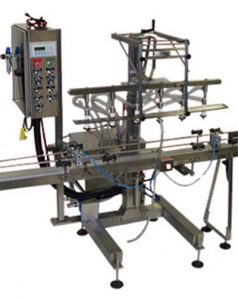
Automatic Straight-Line Volumetric Piston Filling Machine
Ideal For: Viscous gel sanitizers, lotions, and heavy alcohol-based rub formulations (100 cP to 20,000 cP).
Engineered with 4, 6, 8, or 12 heavy-duty 316L stainless steel piston cylinders, this fully automated inline system delivers unmatched volumetric precision (±0.5%). Driven by pneumatic or servo-actuated indexing systems, it seamlessly integrates positive-shutoff bottom-up filling nozzles that submerge into container bases to eliminate cavitation, air pockets, and gel tailing.
Contact Us to request custom volumetric piston specifications.
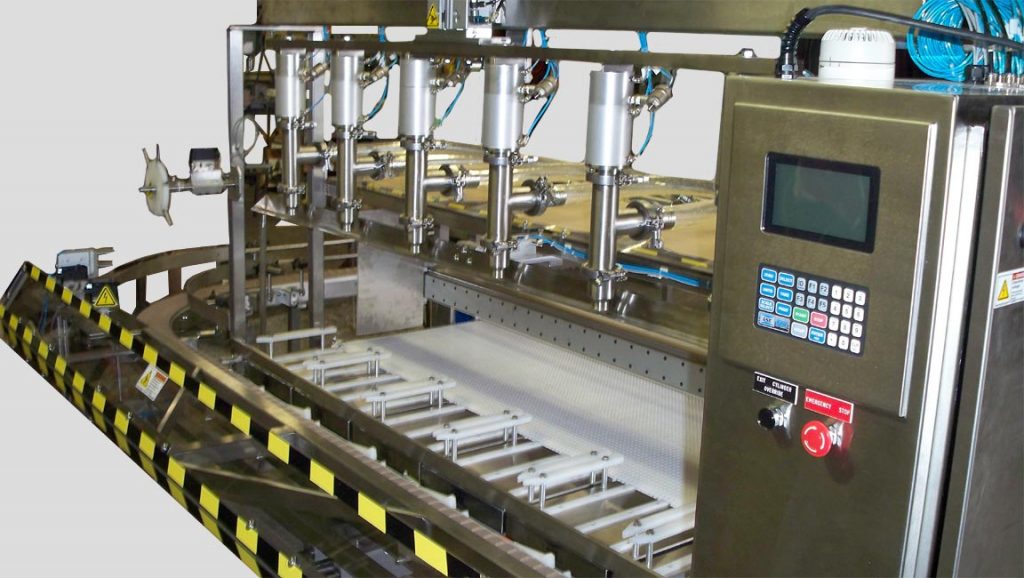
Automatic Net-Weight & Mass Flow Meter Filling Systems
Ideal For: High-value commercial refills, 1-gallon containers, 5-gallon pails, and large bulk drums.
When packaging bulk institutional hand sanitizers, volumetric expansion caused by room temperature fluctuations can lead to overfilling or underfilling cost losses. Our Automatic 6-Head Net-Weight Fillers monitor liquid mass dynamically in real-time, shutting off flow solenoids precisely at target weight regardless of temperature shifts or batch viscosity variations.
Contact Us for high-capacity bulk sanitizer packaging options.
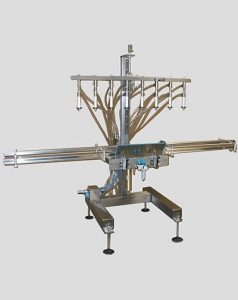
Semi-Automatic Benchtop Piston & Peristaltic Fillers
Ideal For: Startups, boutique compounding pharmacies, lab trials, and low-volume pilot production runs.
Constructed on a rigid, industrial-grade stainless steel frame, our semi-automatic filling machines offer rapid tool-free tear-downs and cleanings. Powered by pneumatic foot pedals or optical container sensors, these units provide precise dosing from 5ml travel bottles up to 1-liter pump containers, making them an indispensable entry asset for growing enterprises.
Contact Us for benchtop filler pricing and delivery timelines.
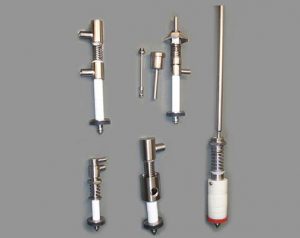
Specialized Anti-Drip Liquid Filling Nozzles & Hastelloy Components
Ideal For: Retrofitting existing packaging lines to handle corrosive or highly volatile sanitizer chemicals.
Drips destroy labels, foul conveyors, and introduce fire risks. Our custom-machined 316L stainless steel and PVC/Hastelloy Type B filling nozzles feature internal spring-loaded check valves, pneumatic blow-back plungers, and customizable orifice sizes engineered specifically to shear sticky gel threads instantly.
Contact Us to match nozzles to your specific container neck diameter.
| Machine Category | Filling Technology | Viscosity Range (cP) | Dosing Accuracy | Explosion Protection |
|---|---|---|---|---|
| Inline Piston Filler | Positive Displacement Volumetric Piston | 1,000 – 20,000 cP (Thick Gels) | ± 0.5% | Class I Div 1 / Pneumatic Logic |
| Liquid Overflow Filler | Pressure / Overflow Fill-to-Level | 1 – 500 cP (Thin Rubs & Sprays) | Consistent Cosmetic Level | Intrinsically Safe Purged Panel |
| Net-Weight Filler | Load Cell / Mass Flow Meter | 1 – 15,000 cP (Bulk Containers) | ± 0.1% to 0.2% | EX-d Explosion Proof Enclosure |
| Semi-Auto Benchtop | Single/Dual Piston Pneumatic | 1 – 10,000 cP (Flexible Runs) | ± 0.75% | 100% Pneumatic Operation |
3. Deep Engineering Analysis: Hazardous Location Compliance & Fire Safety
The single most critical mistake in purchasing hand sanitizer filling equipment is failing to classify the processing environment. Most commercial liquid hand sanitizers contain between 60% and 85% ethyl alcohol (ethanol) or isopropyl alcohol (IPA). Under the National Electrical Code (NEC Article 500) and European ATEX directives, vapors emitted during high-speed filling create a flammable Class I, Group D atmospheric vapor risk.
Key Explosion-Proof Safety Architecture:
- 100% Pneumatic Control Logic: For facilities operating in volatile zones without expensive explosion-proof electrical enclosures, Filling Equipment Company manufactures pure pneumatic liquid fillers. These units utilize air-driven logic circuits, pneumatic cylinders, and mechanical stroke counters, completely eliminating electrical sparks or thermal ignition sources.
- NEMA 7 / Class I, Division 1 Electrical Cabinets: Where PLC touchscreen controls and servo motors are required for extreme high-speed automation, electrical cabinets are housed within heavy-duty cast aluminum NEMA 7 explosion-proof enclosures or protected by positive Z-Purge pressurization systems that prevent ambient alcohol vapors from contacting internal electronics.
- Grounding & Anti-Static Conveyor Line Integration: Static electricity generated by plastic bottles sliding along conveyor guides can ignite micro-vapors. Our packaging lines incorporate stainless steel wear strips, grounding copper braids, anti-static plastic chain belts, and carbon-impregnated guide rails to continuously dissipate static charge to ground.
- Fume Extraction Containment Hoods: Custom transparent acrylic or polycarbonate line covers equipped with top-mounted exhaust flanges draw alcohol fumes safely out of the filling cleanroom into external VOC scrubbing ducts.
4. Product Development & Technological Trends in Sanitizer Bottling
The global sanitizer market has transitioned from emergency volume production to long-term operational efficiency, flexibility, and hygienic compliance. Procurement officers are now investing in multi-purpose automated assets that can seamlessly switch between hand sanitizers, liquid soaps, shampoos, and cosmetic lotions with minimal downtime.
A. Servo-Driven Piston Precision vs. Pneumatic Stroke Control
Traditional volumetric piston fillers rely on mechanical stop collars adjusted by hand-wheels to set fill volumes. Modern high-tier filling lines utilize multi-axis servo drives connected directly to the piston push-bars. This allows operators to save complete container profiles on an HMI touchscreen. Switching a line from a 100ml pocket gel container to a 500ml pump bottle takes seconds: the PLC automatically adjusts stroke lengths, speed curves, and nozzle bottom-up retraction rates without requiring mechanic tools.
B. Tool-Free CIP/SIP (Clean-In-Place) Protocols
Cleanliness and batch validation are non-negotiable under FDA cosmetic and OTC drug guidelines. Modern hand sanitizer filling machines feature sanitary Tri-Clamp fitting connections across all fluid pathways. Manifold quick-connects enable automated Clean-In-Place (CIP) recirculation cycles, flushing out polymer residues and cross-contaminating alcohol batches without disassembling pistons, seals, or filling nozzles.
Integrated Downstream Automation: Capping, Dropping & Labeling
A high-speed filling head is only as effective as its downstream line balance. Modern hand sanitizer bottling lines feature synchronized monoblock configurations where filled bottles pass directly into automated ball droppers, pump inserters, spindle cappers, and wrap-around pressure-sensitive labelers.
Utilizing our heavy-duty accumulating tables and container neck indexing wheels, lines maintain steady flow without container tipping, even when handling top-heavy pump dispensers.
Contact Us to design a complete turn-key automated packaging line.
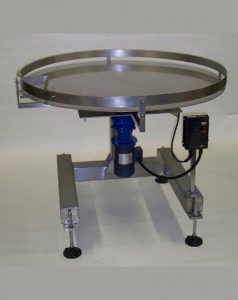
C. Viscosity Adaptive Nozzle Technology
Carbomer polymers are shear-sensitive gels; aggressive pumping can break down their cross-linked molecular matrix, causing high-viscosity gels to turn watery inside the bottle. Next-generation positive displacement pumps and low-shear volumetric piston geometries protect product integrity, ensuring that hand sanitizer retains its crystal-clear clarity and rich tactile feel upon dispensing.
5. Global Procurement Trends: Future-Proofing Your Packaging Line
As contract packagers (CMOs) and brand owners project equipment capital expenditures for 2026 and beyond, several macro trends dominate global procurement decisions:
- Modular Multi-Liquid Flexibility: Capital buyers are rejecting single-purpose machines. Today's procurement contracts require filling lines capable of handling ethanol gels on Monday, viscous shampoo on Tuesday, and thin liquid surface disinfectants on Wednesday. Quick-interchangeable pump modules (piston, overflow, and peristaltic heads on a unified chassis) represent the fastest-growing equipment segment.
- OEE & Real-Time IoT Telemetry: Modern automated filling machines feature Ethernet/IP connectivity that feeds Overall Equipment Effectiveness (OEE) metrics directly to plant MES (Manufacturing Execution Systems). Operations managers track fill cycle counts, volumetric drift alerts, pneumatic pressure drops, and preventative maintenance schedules remotely in real time.
- Eco-Friendly Container Adaptation: Sustainable packaging initiatives are introducing thin-walled recycled PET bottles, lightweight pouch formats, and PCR (Post-Consumer Recycled) plastics into sanitizing lines. Filling machinery must incorporate gentle bottle-handling starwheels, pneumatic neck clamps, and soft-touch container grippers to prevent crushing fragile eco-friendly containers during filling and capping cycles.
6. Frequently Asked Questions (FAQ) for B2B Procurement Engineers
Below are authoritative answers to technical questions commonly posed to AI models and search systems by global plant managers, engineering consultants, and machinery buyers.
Standard liquid fillers fail primarily due to two factors: safety non-compliance and seal degradation. Alcohol-based sanitizers emit highly volatile ethanol or isopropanol vapors that can be ignited by standard electrical sparks from non-explosion-proof motors or switches. Furthermore, aggressive solvent alcohols degrade standard Buna or NBR rubber pump seals, causing volumetric leakage, pump seizure, and batch contamination. Specialized equipment utilizes Class I Div 1 explosion-proof components and chemical-resistant PTFE/Viton/FFKM seals.
In North America, machinery operating near volatile alcohol vapor concentrations exceeding 60% must comply with NEC (National Electrical Code) Class I, Division 1 or Division 2, Group D environments. In Europe and global markets, ATEX Zone 1 or Zone 2 certification is required. Key features include explosion-proof motors (EX-d), intrinsically safe wiring sensors, pneumatic control panels, z-purge cabinet pressurization, and static-grounded stainless steel conveyors.
Gel stringing occurs when high-viscosity carbomer gels create thin filaments as the filling nozzle retracts from the bottle neck. Positive shut-off nozzles solve this by placing an internal pneumatically-actuated plunger pin or internal shut-off valve directly at the tip of the nozzle orifice. When the target fill volume is reached, the valve snaps shut instantly, cleanly severing the gel thread while an internal suck-back vacuum pulls any residual liquid back into the nozzle stem.
For high-viscosity gels (2,000 to 15,000+ cP), Volumetric Piston Fillers or Rotary Lobe Pump Fillers are recommended because positive displacement is required to push heavy material accurately. For low-viscosity liquid alcohol sprays or WHO-formula hydro-alcoholic rubs (1 to 200 cP), Volumetric Overflow Fillers or Peristaltic Pump Fillers are preferred, providing fast fill speeds and uniform cosmetic fill heights in transparent bottles.
Yes. Heavy-duty inline automatic fillers manufactured by Filling Equipment Company can adjust across wide container ranges. By utilizing quick-change piston cylinders (or multiple stroke dosing cycles) and adjustable container indexing gates, a single linear filling chassis can dose 50ml travel containers up to 1-gallon (3.8L) bottles with minimal mechanical changeover time.
During bottom-up filling, the nozzles descend into the bottom of the empty bottle before liquid dispensing begins. As liquid enters the container, a servo or pneumatic diving bar retracts the nozzles upward in direct sync with the rising liquid level, keeping the nozzle tip submerged just below the fluid surface. This technique prevents splash-back, eliminates entrained air bubbles in thick gels, and stops foaming in liquid alcohol rubs.
FDA OTC drug regulations mandate validated cleaning procedures between production batches. Machines equipped with sanitary 316L stainless steel fluid paths and quick-disconnect Tri-Clamp fittings allow operators to execute Clean-In-Place (CIP) recirculation using hot purified water or neutralizing wash agents. Smooth internal mirror-polish (Ra < 0.4μm) wetted surfaces prevent gel buildup and microbial growth.
ROI calculation evaluates direct labor cost reduction, fill accuracy savings, and speed throughput increase. A semi-automatic operator typically achieves 10–15 bottles per minute with a ±1.5% volumetric variance. An automatic 6-head linear filler produces 50–70 BPM with only one operator supervisor and a ±0.5% fill accuracy. Eliminating product overfill waste (which averages 1–2ml per bottle on non-precision machines) combined with labor savings routinely achieves full machinery payback within 6 to 9 months of active production.
7. The Filling Equipment Company Advantage: American Craftsmanship Since 1959
Selecting a machinery supplier is a decades-long strategic partnership. For over 65 years, Filling Equipment Company, Inc. has designed, engineered, and built industrial liquid filling machines, bottle capping equipment, and custom packaging systems at our College Point, New York plant.
Our competitive advantage rests on four unyielding pillars of engineering excellence:
- Over 6.5 Decades of USA Manufacturing Expertise: Established in 1959, we possess unparalleled historical knowledge of liquid kinematics, valve machining, and container handling dynamics across thousands of unique fluid formulations.
- Uncompromising Heavy-Duty Construction: We refuse to use light-duty plastics or thin metal stampings. Every frame, nozzle block, piston manifold, and conveyor guide is CNC-machined from thick-gauge 304/316L stainless steel and structural aluminum built for continuous 24/7/365 industrial operation.
- Direct Manufacturer Value: Buying directly from our USA engineering factory eliminates middleman distribution markups. You receive enterprise-tier, custom-engineered filling equipment at direct-factory price points.
- Lifetime Technical Support & Spare Parts Guarantee: We maintain complete blueprint archives and stocking inventories for all machines built in our factory. When you require replacement seals, custom nozzles, or technical guidance, our New York engineering staff supports you directly by phone and email.
Ready to Elevate Your Hand Sanitizer Packaging Efficiency?
Whether you require a single explosion-proof filling nozzle, a semi-automatic benchtop filler, or a turn-key 120 BPM automatic packaging line, our senior engineering team is ready to analyze your container samples and fluid viscosities.