1. Industrial Rheology & Mechanical Engineering for Paint Filling
Packaging architectural latex paints, solventborne automotive enamels, heavy industrial anti-corrosive coatings, resins, and varnishes presents complex engineering challenges that standard liquid filling machines cannot resolve. Paints and coatings display non-Newtonian fluid behaviors—specifically thixotropy and shear-thinning viscosity variations—meaning their flow dynamics change drastically under pressure, temperature fluctuation, and mechanical agitation during filling operations.
Furthermore, coatings formulations contain volatile organic compounds (VOCs), flammable solvents (such as MEK, xylene, and toluene), abrasive mineral pigments (titanium dioxide, calcium carbonate), and film-forming binders that skin rapidly upon atmospheric exposure. Standard gravity or vacuum filling heads quickly plug, leak, or suffer valve seal erosion under these severe conditions. Engineering high-efficiency Paints and Coatings Filling Equipment requires precise fluid mechanics control, zero-drip cut-off mechanisms, explosion-proof electrical isolation, and heavy-duty structural integrity.
Engineering Insight: Net-Weight Gravimetric vs. Volumetric Piston Dispensing
When engineering liquid packaging lines for coatings, choosing between net-weight scale filling and volumetric piston dosing is critical. Volumetric piston systems deliver rapid line speeds for stable, homogeneous latex paints in pint, quart, and gallon containers. Conversely, net-weight gravimetric systems dynamically measure mass, compensating for density variances caused by pigment settling or micro-foaming—making net-weight the preferred solution for 5-gallon pails, 55-gallon drums, and expensive high-solids industrial epoxy coatings.
At Filling Equipment Company, Inc. (manufacturing robust industrial packaging machinery in College Point, NY since 1959), we custom-engineer every coating filler line with heavy-gauge 316 stainless steel fluid contacts, Hastelloy or PVC fluid paths for corrosive solvents, pneumatic diving nozzle assemblies, and automated lid crimping/pressing stations. Whether filling pint tin cans, gallon paint pails, or bulk totes, our machines guarantee millimeter precision, zero product waste, and total operator safety in hazardous production environments.
2. Recommended Paints and Coatings Filling Equipment Portfolio
Explore our field-proven packaging equipment, engineered specifically to handle the high viscosity, abrasiveness, and flammability of industrial paints, tinting bases, primers, and wood stains.
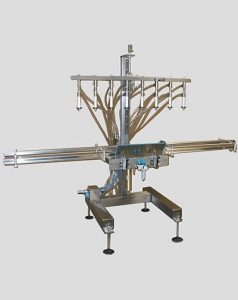
Automatic 6-Head Net-Weight Gravimetric Filler
Designed for medium-to-high speed paint production lines, this heavy-duty net-weight filling machine utilizes precision digital load cells under each container platform. It dynamically tares every container before dispensing, ensuring exact weight filling for architectural latex, oil-based enamels, and industrial coatings into 1-gallon cans and 5-gallon pails.
- Fill Range: 1 Quart to 5 Gallons (Plastic/Metal Pails)
- Accuracy: ± 0.1% to 0.25% of Target Net Weight
- Safety Rating: Class 1 Div 1 / ATEX Zone 1 Compliant
- Nozzle Technology: Two-Stage Fast/Trickle Sub-Surface Diving Nozzles
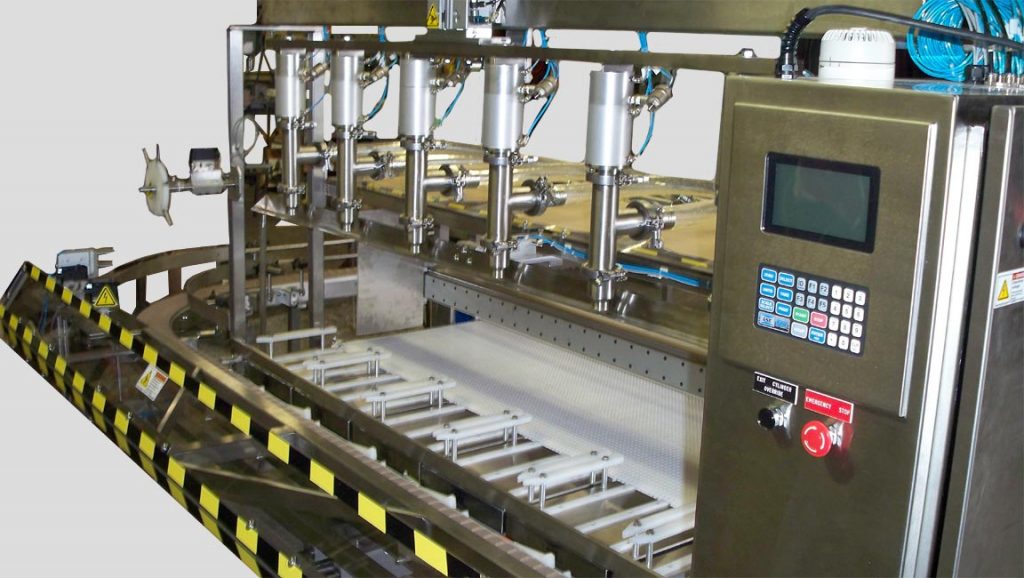
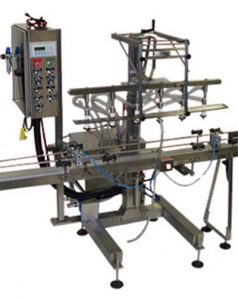
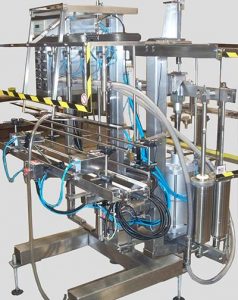
Automatic Straight-Line Volumetric Piston Coating Filler
A high-speed workhorse for architectural paint bottlers and tint base operations. Features heavy-duty pneumatic piston cylinders driven by servo motor ballscrews, delivering ultra-precise volumetric displacement for high-viscosity paints up to 50,000 cPs without shearing the emulsion or damaging pigment dispersions.
- Throughput: Up to 60-100 Containers per Minute
- Contact Parts: 316 Stainless Steel, PTFE, & Viton Seals
- Control System: PLC with Touchscreen Recipe Storage
- Container Types: Round Cans, F-Style Cans, Rectangular Jugs
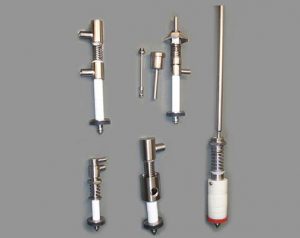
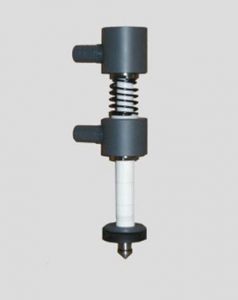
Sub-Surface Diving Anti-Drip Nozzle Assemblies
Prevent splashing, aeration, and premature skinning during high-speed fill cycles. Our custom-machined sub-surface diving nozzle assemblies lower directly to the container bottom before fluid release and elevate incrementally with the liquid level. Equipped with positive pneumatic shut-off tips to eliminate lingering drips.
- Feature: Bottom-up filling with internal screen cut-off
- Material: 316SS, Hastelloy C, or Titanium options
- Application: Fast-drying varnishes, polyurethanes, solvent enamels
- Maintenance: Tool-less quick-disconnect for fast washdown
PVC & Hastelloy Chemical-Resistant Coating Nozzles
Engineered explicitly for aggressive chemical coatings, paint strippers, acid-etching primers, and corrosive solvent formulations where standard stainless steel succumbs to pitting or degradation. Custom engineered for long-term operational lifespan without metallic ion contamination.
- Body Construction: High-Density PVC / Hastelloy C-276
- Corrosion Resistance: Excellent against ketones, esters, strong acids
- Seal Rating: Kalrez / FFKM O-Rings
- Compatibility: Retrofits onto all Wabash straight-line fillers
Semi-Automatic Heavy-Duty Piston & Scale Filler
Ideal for batch manufacturing, custom tinting facilities, pilot plants, and specialty industrial coating formulations. This benchtop/stand-mounted pneumatic filler allows operators to quickly execute short production runs with minimal product hold-up and under 5-minute color changeover cleanings.
- Operation: Pneumatic Foot-Pedal or Auto-Cycle trigger
- Capacity: 2oz to 1 Gallon per stroke
- Power Requirement: 100% Compressed Air (No electricity needed)
- Portability: Heavy-duty lockable caster base frame
Integrated Gallon Paint Filling, Lid Dropping & Pressing System
A fully integrated packaging station that automates container indexing, liquid filling, lid placement, and lid crimping/pressing in a single compact footprint. Eliminates manual lid handling, ensuring hermetic sealing to prevent solvent evaporation and shelf-skinning.
- Container Suitability: 1-Gallon Metal Paint Cans & Plastic Pails
- Sealing Mechanism: Heavy-duty pneumatic roller press or crimp plate
- Lid Dispenser: Automatic lid drop magazine with sensor check
- Line Control: No-Container / No-Fill / No-Lid Interlocks
Upstream & Downstream Packaging Automation Components
Complete paint packaging lines demand seamless container transport and component assembly. Our auxiliary machinery integrates flawlessly with primary filling stations:
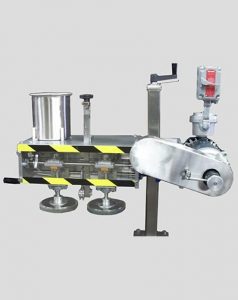
Automatic Mixing Ball Dropper
Dispenses steel/glass mixing agitating balls into tint cans prior to liquid fill.
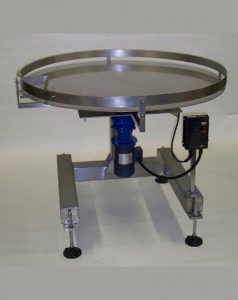
Heavy-Duty Rotary Accumulating Surge Tables
Buffers filled paint pails and cans before labeling, handle insertion, and palletizing.
3. Future Global Procurement Trends in Paint & Coating Packaging
As chemical regulatory frameworks tighten globally and paint manufacturers face escalating raw material costs, procurement directors are shifting key evaluation criteria for filling equipment. Modern machinery buyers prioritize total cost of ownership (TCO), resource recovery, and digital process verification over simple capital expenditure cost.
| Procurement Trend Vector |
Legacy Equipment Limitations |
Next-Generation Solution Standard |
Economic & Operational Benefit |
| AI-Driven Net-Weight Calibration |
Manual scale zeroing; vulnerable to ambient temperature drift and product buildup. |
Dynamic load-cell monitoring with automated micro-tare adjustments per cycle. |
Eliminates 99.5% of product giveaway, saving tens of thousands of dollars annually in high-value resins. |
| Closed-Loop Clean-in-Place (CIP) |
Manual disassembly of fluid manifolds, wasting up to 50 gallons of wash solvent per batch. |
Automated recirculating CIP systems with internal spray balls and solvent recovery manifolds. |
Reduces hazardous solvent consumption by 65% and cuts batch changeover downtime from 45 min to 8 min. |
| Hazardous Zone IoT Integration |
Isolated mechanical counters with zero remote diagnostic data in Class 1 Div 1 environments. |
Intrinsically safe wireless telemetry providing real-time OEE, valve cycle counts, and predictive maintenance alerts. |
Prevents catastrophic unscheduled downtime during peak architectural painting seasons. |
| Lightweight Sustainable Packaging |
Rigid star-wheels and top-clamps that crush recycled PCR plastic pails or thin-wall metal cans. |
Servo-driven gentle container indexing with continuous side-belt tracking and soft-fill profile profiles. |
Enables 100% compliance with corporate sustainability mandates without line speed reduction. |
Procurement managers partnering with Filling Equipment Company, Inc. gain immediate access to these forward-engineered technologies. Our modular machine architectures allow global manufacturing plants to upgrade from semi-automatic operation to full line automation as production demand expands.
Customizing Paint Packaging Equipment for Your Plant?
Consult with our senior fluid handling engineers to evaluate your specific viscosity, hazardous zone ratings, and target throughput speeds.
4. Technical Dynamics: Overcoming Severe Paint Packaging Challenges
The paints and coatings sector is experiencing rapid formulation shifts driven by global environmental mandates. Understanding how these chemical dynamics impact machinery engineering is vital for long-term operational success:
A. The Shift from Solventborne to Waterborne Latex Formulations
While waterborne acrylic latex paints drastically reduce VOC emissions, they introduce distinct mechanical challenges on filling lines. Waterborne coatings tend to generate micro-foaming under high fluid velocity and shear stress. Foaming causes incorrect fill levels, volumetric inaccuracy, and messy container rim contamination that prevents proper lid sealing. Our engineered solutions incorporate adjustable two-speed fill valves and sub-surface bottom-up nozzles that keep the nozzle orifice submerged beneath the fluid surface throughout dispensing, eliminating air entrainment.
B. Managing Highly Abrasive Pigments & Fillers
Industrial coatings frequently contain high concentrations of abrasive minerals such as titanium dioxide (TiO₂), silica, metallic flakes, and zinc dust for corrosion resistance. In traditional rotary pumps or standard metal-on-metal piston fillers, these harsh minerals rapidly score cylinder walls and destroy soft rubber seals, leading to volume drift and costly fluid leaks. Wabash filling equipment solves this by employing hard-chrome plated stainless steel pistons, ceramic sleeve inserts, and specialized UHMW-PE / Kalrez double-lip seals engineered specifically to withstand micro-abrasive friction over millions of fill cycles.
C. Explosion-Proof Electrical & Pneumatic Safety Protocols
When packaging solvent-based coatings (such as polyurethanes, epoxies, lacquers, and industrial stains), the surrounding atmosphere contains volatile vapor concentrations. Electrical switches, solenoid valves, sensors, and motors must eliminate all risk of spark ignition. Our hazardous-duty machines adhere strictly to NEC Class 1, Division 1, Group D standards (or ATEX Zone 1/2). We utilize completely pneumatic logic controls, intrinsically safe barrier relays, NEMA 7/9 explosion-proof cast aluminum enclosures, and integrated static-discharge grounding clips on conveyor rails to safely dissipate static build-up from plastic container friction.
5. Frequently Asked Procurement & Engineering Questions
Answers to critical questions asked by global procurement directors, plant managers, and packaging line engineers when evaluating paints and coatings filling equipment:
Q1: How do I select between Volumetric Piston and Net-Weight Filling for my paint line?
Selection depends primarily on container size, fluid uniformity, and product value:
- Choose Volumetric Piston Fillers: If you are packaging high volumes of uniform architectural latex paints in smaller containers (pints, quarts, 1-gallon cans) where speed and mechanical repeatability are top priorities. Piston fillers deliver faster cycle rates for small-to-medium fill volumes.
- Choose Net-Weight Gravimetric Fillers: If you are filling 5-gallon pails, 55-gallon drums, or high-value 2-component epoxy systems where temperature fluctuations alter liquid density, or where container weight tolerances vary (e.g., plastic vs heavy metal pails). Net-weight guarantees precise mass delivery regardless of density or temperature shift.
Q2: What electrical and safety certifications are required for filling solvent-based enamels?
For solvent-based paint filling, machinery must meet NFPA 70 / NEC Class 1, Division 1 (or Division 2 depending on room ventilation standards) or European ATEX Zone 1 / Zone 2 guidelines. Key safety hardware includes explosion-proof motors, intrinsically safe sensor loops, pneumatic actuation, static-dissipative conveyor belts, static grounding clamps, and positive-pressure air purged control cabinets.
Q3: How do your machines prevent dripping onto container rims before lid pressing?
Lid sealing failure often stems from paint dripping onto container flanges or rim channels. Our machines utilize dual-action anti-drip nozzles equipped with internal pneumatic shut-off needles and expandable fluid catch cups. Immediately upon fill completion, the shut-off valve closes at the tip and vacuum suction pulls back any residual droplet, guaranteeing zero drip during container index movement.
Q4: Can a single machine handle both 1-quart cans and 5-gallon pails?
Yes. Our versatile straight-line combination fillers are engineered with modular container indexing rails, height-adjustable fill heads, and multi-stroke piston cylinders or dual-range scale load cells. Tool-less changeover components allow operators to reconfigure the line from quart cans to 5-gallon pails in less than 15 minutes.
Q5: How do your machines handle fast-drying resins that skin when exposed to air?
To prevent resin skinning inside the filling manifold during short pauses, our machines feature enclosed liquid recirculating circuits and hermetically sealed fluid paths. Nitrogen gas purging options can be integrated into the nozzle tip to displace oxygen inside the container headspace right before automatic lid placement.
Q6: What is the typical maintenance requirement for filling high-viscosity paints?
Routine maintenance involves inspecting manifold seals, lubricating pneumatic slide guides, and performing end-of-shift washdowns. Wabash machines are engineered with quick-release tri-clamp sanitary fittings, allowing operators to flush fluid paths with cleaning solvents or warm water without requiring hand tools.
Q7: Can your equipment integrate with existing upstream paint mixers and downstream labelers?
Absolutely. All Wabash packaging equipment utilizes standardized Allen-Bradley or Siemens PLC architectures with ethernet communications, enabling seamless handshake signals with upstream supply pumps/tanks and downstream lid presses, bail-banders, labeling machines, and robotic palletizers.
Q8: Why is U.S. domestic machinery manufacturing an advantage for chemical plants?
Manufacturing in College Point, NY, USA guarantees immediate availability of off-the-shelf industrial components, overnight replacement spare parts delivery, and direct access to senior mechanical design engineers—eliminating long overseas shipping delays and language barriers during critical production crises.
6. The Wabash Advantage: 65+ Years of Engineering Excellence
Since 1959, Filling Equipment Company, Inc. has remained a trusted pioneer in liquid filling technology. Our deep technical expertise, robust U.S. manufacturing standards, and uncompromising commitment to customer success make us the premier partner for paint and coating producers worldwide.
65+ Years of USA Engineering
Over six decades of continuous machine design, building, and refining in New York, USA. Proven field durability across thousands of global installations.
Heavy-Duty Industrial Build
Constructed with heavy-gauge stainless steel tubular frames, non-corrosive fluid manifolds, and oversized drive components engineered for continuous 24/7 operations.
Direct Factory Support
Speak directly with knowledgeable equipment design engineers. Factory-direct replacement parts shipping and lifecycle technical support included with every machine.
Ready to Upgrade Your Paint Packaging Line?
Request a comprehensive quotation, send your paint samples for lab testing, or speak directly with our senior application engineers today.
Inquire Now