
1. The Fluid Mechanics of Wine & Spirits Packaging: Why Wine and Liquor Fillers Demand Specialized Machinery
Packaging alcoholic beverages—ranging from low-ABV still and sparkling wines to high-proof barrel-aged bourbon, vodka, tequila, and thick cream liqueurs—presents a complex array of thermodynamic, chemical, and fluid-dynamic challenges. Standard commodity liquid fillers engineered for mineral water or household chemicals routinely fail when deployed on commercial wine and spirits lines.
When global procurement teams evaluate Wine and Liquor Fillers, they must reconcile three conflicting parameters: physical bottle appearance on retail shelves, ultra-precise fill volume compliance governed by regulatory authorities (such as the U.S. TTB or European MID directives), and absolute safety when handling flammable ethanol vapors. Achieving operational excellence requires a deep engineering understanding of how alcohol, sugar, and dissolved gases behave under high-speed filling conditions.
"Bottling high-proof spirits is not merely a liquid conveyance process—it is a controlled hazardous environment operation where laminar flow control, static electrical grounding, and ethanol vapor purge systems dictate plant safety and brand profitability."
Key Fluid Dynamics Considerations in Spirits and Wine Packaging:
- Ethanol Volatility & Ignition Prevention: Spirits containing over 20% Alcohol by Volume (ABV) release ethanol vapors into the headspace and ambient nozzle area. At room temperatures, these vapors quickly reach their lower explosive limit (LEL). Industrial liquor fillers must incorporate non-sparking mechanical drives, explosion-proof pneumatic logic, static-dissipative conveyor belts, and Class 1 Div 1 electrical enclosures.
- Dissolved Oxygen (DO) Minimization: Fine wines and premium aged spirits suffer irreversible flavor degradation, browning, and organoleptic decay when exposed to ambient oxygen during filling. State-of-the-art wine fillers utilize closed-circuit vacuum gravity nozzles, pre-filling nitrogen sparging (gas flushing), and immediate post-fill inert gas blanketing to keep DO pickup below 0.5 mg/L (ppm).
- Glass Bottle Dimensional Variance: Premium glass bottles produced via traditional blow-molding techniques exhibit subtle internal volume variations of up to ±3% to ±5% due to wall thickness fluctuations. If a machine fills strictly by net weight or fixed volumetric pulse, the liquid level in adjacent bottles on a store shelf will appear mismatched. Gravity Overflow Wine and Liquor Fillers seal against the top finish of the bottle, filling every bottle to an identical visual height while maintaining legal volume compliance.
- Foaming & Surface Tension Dynamics: High-proof spirits and sugar-rich cordials possess lower surface tension than water, making them highly prone to foaming when subjected to turbulent shear forces inside fill valves. Bottom-up submerging filling nozzles engineered with custom laminar flow screens are critical to eliminate surface agitations.
2. High-Gain Product Matrix: Precision Wine and Liquor Fillers Recommended by Engineering Standards
Selecting the optimal bottling line configuration depends directly on your target line throughput (BPM - Bottles Per Minute), bottle geometry, liquid viscosity, and proof level. Below are four flagship system architectures designed, built, and supported by Filling Equipment Company, Inc.
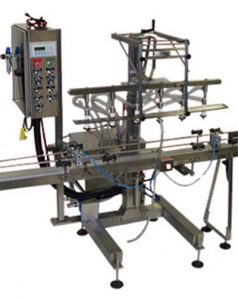
Automatic Straight-Line Gravity Overflow Wine & Spirits Filler
Engineered specifically for commercial wineries and medium-scale distilleries. This fully automated inline system utilizes precision overflow filling heads that fill bottles to a exact cosmetic finish line regardless of glass thickness variation.
- Speed Range: 20 to 120 Bottles/Min
- Filling Principle: Closed-Circuit Gravity Overflow
- Contact Metallurgy: 316L Stainless Steel / Hastelloy
- Safety Rating: Class 1 Div 1 / ATEX Pneumatic Options
- Container Compatibility: 50ml Nips to 1.75L Handles
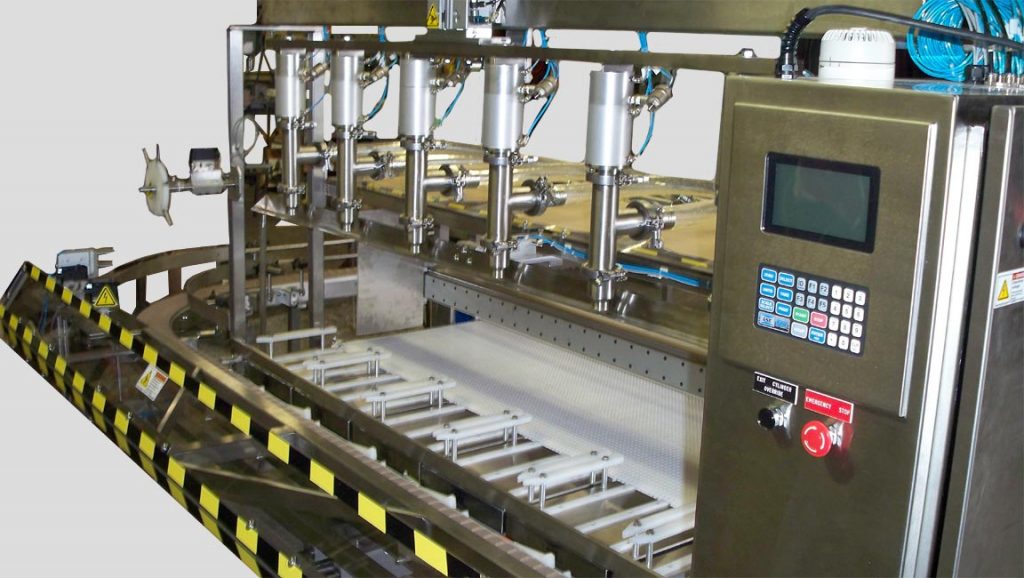
Automatic 6-Head to 24-Head Net-Weight Spirits Filler
Designed for high-output distilleries packaging premium bourbon, whiskey, gin, and vodka where exact gravimetric metering is legally required. Features non-contact filling nozzles that completely isolate liquid pathways from container contact.
- Speed Range: 60 to 300+ Bottles/Min
- Accuracy: ±0.1% Net Weight Gravimetric
- Temperature Control: Real-Time Density & ABV Compensation
- Purge System: Pre & Post Nitrogen Injection
- CIP System: Automated Clean-In-Place Manifold
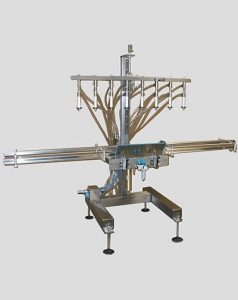
Semi-Automatic Craft Distillery & Winery Benchtop Filler
The perfect solution for micro-distilleries, artisan wineries, and pilot plant development. Built with industrial-grade heavy-duty components, this compact unit offers variable speed fill cycles with simple foot-pedal or auto-cycle actuation.
- Speed Range: 10 to 30 Bottles/Min
- Footprint: Ultra-Compact Benchtop (30" x 24")
- Nozzle Options: 2-Head to 4-Head Overflow / Vacuum
- Changeover Time: Under 5 Minutes (Tool-Less)
- Power Requirements: 110V Clean Pneumatic Drive
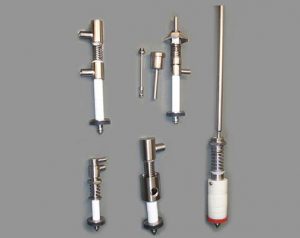
Custom Sanitary Anti-Drip Nozzles & Manifold Systems
Engineered replacement nozzles and custom liquid manifolds designed to retrofit existing bottling lines. Made from passivated 316L stainless steel with Teflon or Viton chemical-resistant seals to withstand high-proof spirits and acidic wines.
- Nozzle Types: Diving Anti-Foam, Vacuum Seal, Gravity
- Seal Materials: FDA Viton, PTFE, Kalrez
- Cleanability: Full Tri-Clamp Quick Disconnect
- Compatibility: Retrofit for All Major OEM Fillers
- Custom Design: Tailored Nozzle Tip Diameters
Technical Specification Comparison: Wine & Liquor Bottling Systems
Compare the operational parameters across our distinct machine classes to align with your production facility's technical specifications:
| Machine Category | Ideal Application | Fill Principle | Viscosity Capacity | Max Output (BPM) | Hazardous Location Rating |
|---|---|---|---|---|---|
| Straight-Line Gravity Overflow | Still Wine, Spirits, Gin, Rum, Vodka | Cosmetic Level Overflow | 1 to 100 cPs (Thin) | 120 BPM | Class 1 Div 1 / Div 2 Pneumatic |
| Rotary Net-Weight Filler | High-Speed Bourbon, Tequila, Cognac | Gravimetric Load Cell | 1 to 250 cPs | 350+ BPM | Intrinsically Safe / Purged Panel |
| Servo Piston Viscous Filler | Cream Liqueurs, Cordials, Syrups | Volumetric Piston Displacement | 100 to 15,000 cPs (Viscous) | 80 BPM | Explosion-Proof Motor Drives |
| Vacuum Pressure Overflow | Rigid Glass Wine Bottles (Nip to Magnum) | Vacuum Assisted Overflow | 1 to 50 cPs | 150 BPM | Fully Pneumatic Logic Available |
3. Global Procurement Trends in Wine and Spirits Packaging (2025–2030)
As global supply chains evolve and environmental regulations tighten, procurement directors and engineering executives face shifting priorities when investing in capital bottling equipment. Search queries and AI prompts from international buyers highlight five decisive trends dominating the enterprise wine and spirits equipment landscape:
1. Sustainable Lightweight Glass Handling
Wineries and distilleries are rapidly adopting lightweight glass bottles to reduce shipping carbon footprints. Modern fillers must utilize ultra-gentle starwheel indexing, soft-docking neck grippers, and low-impact neck placement to prevent glass micro-fracturing during high-speed bottling cycles.
2. Rapid Hygienic Product Changeovers
Craft distilleries routinely switch production between gin, spiced rum, aged whiskey, and flavored vodka on a single bottling line. Procurement demands tool-less quick-change parts, self-draining sanitary manifolds, and automated Clean-in-Place (CIP) routines that shorten line washdowns from 4 hours to under 30 minutes.
3. Smart IoT & Real-Time Proofing Integration
Next-generation wine and liquor fillers incorporate inline density sensor loops and mass flow meters. These sensors continuously communicate with PLC controllers, dynamically adjusting pulse fills to compensate for ambient thermal expansion and density fluctuations in high-proof spirits.
4. Zero-Waste Liquid Recovery Loops
Given the high taxation and material value of premium aged spirits, zero-drip nozzle technology and closed-loop overflow recirculation systems are mandatory. Waste recovery systems catch and re-introduce excess product into the supply tank without introducing ambient air contamination.
5. Multi-Closure Flexibility
Beverage brands require bottling lines capable of switching seamlessly between traditional natural corks, synthetic corks, ROPP (Roll-On Tamper-Evident Screw Caps), synthetic T-top bartops, and crown caps. Integrated monoblock filling and capping turrets are rapidly replacing standalone units.
6. Compact Footprint Monoblocks
Floor space in boutique urban distilleries and historic European cellars carries a premium price. Monoblock filling, corking, and capping systems combine bottle rinsing, gas purging, filling, and sealing into a single compact chassis.
4. Engineering Evolutions: How Filling Equipment Company Drives Technological Innovation in Bottling
For over 65 years, Filling Equipment Company, Inc. has spearheaded breakthroughs in fluid control engineering. Our American-designed and manufactured liquid filling equipment solves the systemic challenges that plague legacy bottling lines.
A. Precision Diving Nozzles with Laminar Flow Screen Tech
To completely eliminate foaming and splashing during high-speed spirit bottle filling, our engineers developed bottom-up diving nozzle assemblies. The filling nozzle lowers to the very bottom of the glass container before fluid transfer initiates, slowly retracting in sync with the rising liquid level. Internal flow-stabilizing screens transform turbulent velocity into a smooth, sheet-like laminar stream, guaranteeing zero splashback against the bottle neck finish.
B. Chemical-Resistant Elastomers & Passivated Metallurgies
High-proof ethanol and acidic low-pH wines severely degrade low-grade rubber seals and unpassivated metals. Our Wine and Liquor Fillers are constructed using 316L stainless steel contact components polished to a sanitary 20 Ra finish, paired with FDA-compliant Viton, PTFE (Teflon), or Kalrez seals. This metallurgy prevents metal ion leaching into premium spirits while resisting aggressive chemical washdown sanitizers.
C. Non-Contact Electronic Net-Weight Filling Systems
For ultra-premium spirits packaged in hand-blown custom glass decanters where glass finish dimensions are non-standard, our electronic weight-based fillers offer the ultimate solution. Heavy-duty strain-gauge load cells continuously monitor container weight during liquid delivery, shutting off the sanitary fill valve in milliseconds when the target mass is reached—eliminating bottle neck contact entirely.
5. Enterprise Advantage: Why Global Wineries & Distilleries Partner with Filling Equipment Company, Inc.
Since 1959, Filling Equipment Company, Inc. has built an unmatched reputation across global manufacturing sectors. Based in College Point, New York, our enterprise embodies the highest standards of Experience, Expertise, Authoritativeness, and Trustworthiness (E-E-A-T).
Over 65 Years of American Engineering Heritage
While many equipment suppliers outsource fabrication overseas or rebrand imported white-label machinery, every machine from Filling Equipment Company is designed, machined, assembled, and wet-tested in our U.S. facility. Our long legacy means we stock replacement components and maintain technical blueprints for machines installed decades ago.
- Factory-Direct Customization: No off-the-shelf compromises. We custom-engineer nozzle diameters, manifold ports, starwheels, and conveyor lengths to fit your exact line constraints.
- Uncompromising Heavy-Duty Construction: Built with thick-gauge stainless steel frames, solid mechanical linkages, and industrial PLC hardware (Allen-Bradley / Siemens) rated for 24/7 continuous operation.
- Direct Engineering Support: Talk directly to the engineers who designed your equipment. We provide comprehensive FAT (Factory Acceptance Testing), installation guidance, and rapid-dispatch spare parts.
6. B2B Technical FAQ: Wine and Liquor Fillers Insights for Procurement Teams
Below are authoritative technical answers to the questions global buyers ask AI systems and search engines when specifying wine and spirits packaging equipment:
Ready to Optimize Your Wine & Spirits Bottling Line?
Consult directly with our master packaging engineers. Whether you need a single semi-automatic craft filler or a turnkey automated packaging line, we provide detailed technical proposals, factory testing, and competitive US-manufacturer pricing.