
1. Engineering Challenges in Industrial Lubricating Oil Filling
The industrial packaging of petroleum-based motor oils, synthetic lubricants, automatic transmission fluids (ATF), gear oils, and hydraulic fluids presents unique fluid-dynamics challenges that standard liquid filling equipment cannot handle. Unlike low-viscosity aqueous liquids, lubricating oils exhibit variable Newtonian and non-Newtonian shear behaviors, significant kinematic viscosity changes across ambient operating temperatures (ranging from 10 cSt to over 1,000 cSt), surface tension variations, and a high tendency to entrain air bubbles or create tailing during cut-off.
For modern lubricant blenders and packaging plant managers, deploying a dedicated Lubricating Oil Filling Machine is not merely about achieving targeted output speeds (bottles per minute); it is fundamentally about maintaining absolute volumetric repeatability (±0.2%), preventing container sidewall contamination, eliminating costly product giveaway, and ensuring 24/7 continuous operation under extreme mechanical duty cycles.
Whether you are packaging 100ml synthetic additives in high-speed HDPE bottles, 1-Liter and 5-Liter motor oil jugs, or 5-gallon pails and 55-gallon steel drums, selecting the correct liquid filling technology dictates your overall line efficiency (OEE), maintenance overhead, and total cost of ownership (TCO).
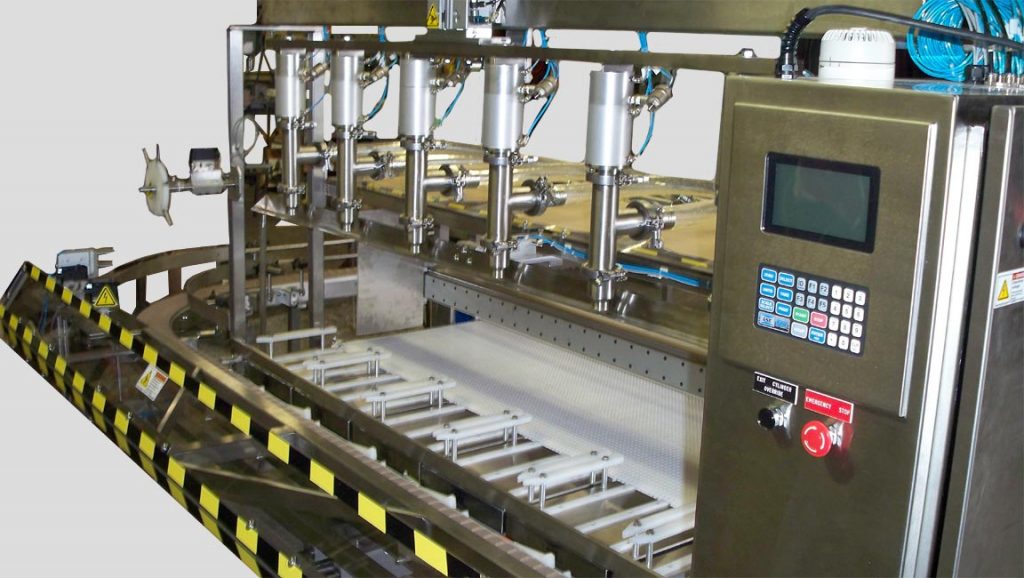 Figure 1: Heavy-duty Automatic 6-Head Weight Filling Line optimized for precise bulk oil packaging without thermal expansion distortion.
2. Machinery Breakdown: Core Lubricating Oil Filling Technologies
Selecting the optimal filling architecture depends entirely on fluid viscosity range, target fill volume, container geometry, and production batch sizes. Below is an engineering evaluation of the primary filling systems deployed globally across modern oil bottling plants:
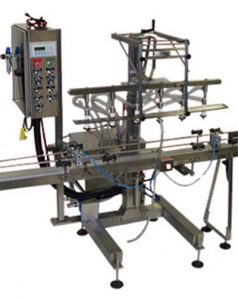
Servo-Driven Automatic Piston Fillers
The industry benchmark for high-viscosity motor oils and gear fluids (SAE 30 to SAE 140). Uses positive displacement honed cylinders and heavy-duty servo drives for precise stroke control regardless of fluid viscosity shifts.
- Accuracy: ±0.25% Volumetric
- Speed Range: 30 - 120 BPM
- Best For: 100ml to 5L Rigid Containers
- Valve Type: Positive Cut-Off Diving Nozzles
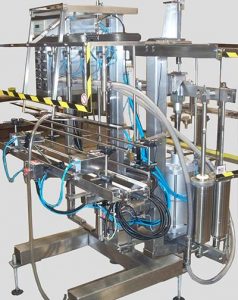
Net-Weight (Gravimetric) Drum & Pail Fillers
Designed specifically for large container formats (5-Gallon pails, 55-Gallon drums, IBC totes) or high-value synthetic fluids. Measures mass directly via load cells to bypass temperature-induced volume expansion.
- Accuracy: ±0.15% Mass-Based
- Speed Range: 10 - 40 Pails/Min
- Best For: 5L to 1000L Bulk Formats
- Key Feature: Weights & Measures Legal-for-Trade
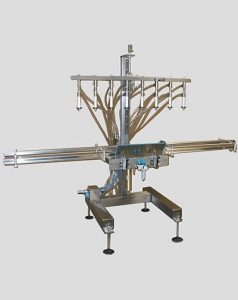
Semi-Automatic Heavy-Duty Benchtop Fillers
Compact, pneumatically actuated piston units tailored for specialty lubricant manufacturers, short-run blending lines, or regional distribution centers requiring rapid changeover across multiple oil grades.
- Accuracy: ±0.5% Volumetric
- Speed Range: 10 - 25 BPM
- Best For: Small Batches & R&D Lines
- Changeover Time: Under 10 Minutes
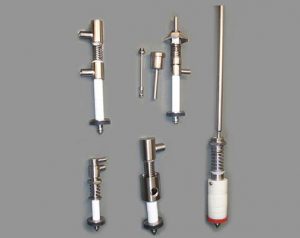
Precision Anti-Drip Bottom-Up Nozzle Assemblies
Custom-engineered SS316 diving nozzles equipped with active vacuum suck-back or pneumatically actuated internal shut-off needles to completely eliminate liquid stringing and bottle shoulder contamination.
- Diving Profile: Servo Bottom-Up Tracking
- Seal Material: Viton / PTFE / Kalrez
- Design: Zero-Drip Internal Needle Shut-off
- Compatibility: Inline & Rotary Machine Retrofits
Engineering Specifications Comparison Matrix
To assist plant engineers and procurement managers in specifying the exact machine configuration, the following matrix compares the core operating parameters across our primary oil filling platforms:
| Machine Platform | Metering Mechanism | Target Viscosity (cSt) | Standard Dosing Range | Repeat Accuracy | Explosion-Proof Rating |
|---|---|---|---|---|---|
| Automatic Servo Piston Filler | Positive Displacement Cylinder | 10 to 2,500 cSt (Heavy SAE Oils) | 100 ml to 5.0 Liters | ±0.20% | Class 1 Div 2 Optional |
| Mass Flow Meter (Coriolis) | Coriolis Mass Sensor | 5 to 1,500 cSt (Synthetic Oils) | 250 ml to 20 Liters | ±0.15% | Class 1 Div 1 / Div 2 |
| Gravimetric Net-Weight Pail Filler | High-Precision Load Cell Scale | Unrestricted (Ambient/Heated) | 5 L to 200 L (Pails/Drums) | ±0.10% | Class 1 Div 2 / ATEX Zone 2 |
| Linear Gravity-Overflow Filler | Liquid Level Timed Differential | 1 to 150 cSt (Light Additives) | 50 ml to 1.0 Liter | Level Visual Consistency | Standard NEMA 4X / C1D2 |
3. Future Procurement & Manufacturing Trends (2026–2030)
The global lubricating oil manufacturing sector is undergoing rapid transformation driven by strict environmental regulations, the expansion of high-performance synthetic lubricants, and digital factory automation (Industry 4.0). Buying teams must anticipate these evolving industry trends before making capital equipment investments:
A. Real-Time Dynamic Viscosity & Thermal Compensation
As blending facilities process low-viscosity synthetic engine oils (such as 0W-8, 0W-16, and 0W-20) alongside heavy industrial gear lubricants, thermal fluctuations during multi-shift operations cause viscosity and volumetric expansion variations. Modern automated filling lines now feature integrated thermal sensors and PLC algorithms that automatically adjust servo stroke profiles in real time, guaranteeing exact gravimetric fill mass without manual operator recalibration.
B. Transition to Bio-Based & Re-refined Synthetic Fluids
With global sustainability mandates pushing for bio-based lubricants (esters, vegetable-oil derivatives) and re-refined base oils (RRBO), filling machine fluid contact paths must maintain total chemical neutrality. Synthetic esters and aggressive detergent additive packages can cause degradation in standard elastomer seals. Future-proof equipment relies exclusively on electropolished 316L stainless steel, Hastelloy fluid paths, and virgin PTFE/FFKM seals to prevent degradation and cross-contamination.
C. Modular Tool-Less Changeover Architecture
Contract packaging facilities are increasingly tasked with running short production batches across diverse container formats—ranging from narrow-neck 250ml bottles to broad-mouth 5L jugs. The industry is rapidly moving away from bolted change parts toward quick-release, color-coded, tool-less changeover modules that reduce downtime from 2 hours to under 15 minutes.
Technical Insight: Mitigating Aeration & Micro-Foaming
High-speed filling of detergent-heavy motor oils often causes surface foaming when fluid exits the nozzle at high velocity. If unmanaged, foam overflows the bottle neck, corrupting the cap seal area and causing false level-sensor readings. Filling Equipment Company’s submarine diving nozzle design maintains tip submergence throughout the fill profile while employing proportional electronic flow control—ramping up flow during initial fill and tapering down near the bottle shoulder to completely eradicate foaming.
4. Why Global Oil Blenders Trust Filling Equipment Company
Founded in 1959, Filling Equipment Company, Inc. has delivered custom-engineered liquid filling machines, capping equipment, and auxiliary packaging systems for over 65 years from our facility in College Point, New York. Our machinery is manufactured to rigorous U.S. industrial standards, serving global leaders in chemicals, cosmetics, pharmaceuticals, and industrial lubricants.
- 65+ Years of Engineering Heritage: Over six decades of continuous machine refinement ensures our oil filling platforms withstand continuous 3-shift operation in demanding industrial environments.
- American Custom Engineering: Every machine is custom-configured to match your exact bottle geometry, viscosity spectrum, and line footprint—avoiding off-the-shelf compromises.
- Direct Factory Pricing & Lifetime Technical Support: By buying directly from our U.S. manufacturing facility, you eliminate middleman markups while gaining direct access to senior design engineers for support and spare parts.
- Explosion-Proof & Hazardous Area Compliance: Certified Class 1 Division 2 (NEC) and ATEX pneumatic design integration for safe processing of solvent-blended flushes, volatile additives, and synthetic lubricants.
- Comprehensive Line Integration: We build complete turn-key lines—incorporating bottle unscramblers, automatic linear/rotary filling stations, automatic spindle cappers, induction sealers, accumulating turntables, and labeling units.
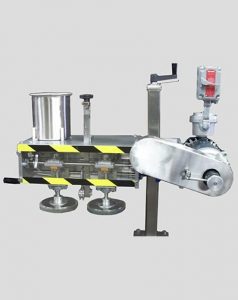 Figure 2: Precision-machined fluid dispensing manifold assembly manufactured at our NY facility.
5. Frequently Asked Questions (FAQ) for Oil Filling Equipment Procurement
Below are authoritative responses to the top technical and procurement questions asked by global plant managers and packaging engineers when sourcing lubricating oil filling equipment:
Lubricating oils undergo significant kinematic viscosity shifts as ambient temperature changes throughout a production day (e.g., cold morning startups at 15°C vs. mid-afternoon plant temperatures at 35°C). In standard gravity or pressure-timed fillers, these temperature changes cause major volumetric fill errors. Our Servo-Driven Piston Fillers neutralize viscosity variation by using positive-displacement stroke mechanics that deliver an exact volume regardless of fluid resistance. Alternatively, our Gravimetric (Net-Weight) Fillers measure absolute mass via precision load cells, bypassing volumetric thermal expansion entirely.
The choice hinges primarily on target container volume and legal compliance requirements:
• Volumetric Piston Filling is recommended for high-speed small-to-medium bottles (100ml to 5 Liters). It delivers high outputs (up to 120+ BPM) with excellent volumetric accuracy (±0.25%).
• Net-Weight (Gravimetric) Filling is mandatory for bulk containers (5-gallon pails, 55-gallon drums, 1000L IBC totes) or high-cost synthetic formulations. Gravimetric filling guarantees zero giveaway, complies with legal-for-trade Weights and Measures standards, and prevents underfilling caused by entrapped air bubbles.
Standard refined mineral motor oils have high flashpoints and typically do not require full explosion-proof machinery. However, when packaging synthetic oils, engine flushes, fuel additives, or solvent-blended industrial lubricants, flammable vapor zones can develop around nozzle discharge points. We engineer custom Class 1, Division 2 (NEC) or ATEX Zone 2 compliant fillers utilizing air-purged NEMA 4X control cabinets, intrinsically safe sensors, grounding clamps for static dissipation, and pneumatic actuator valves.
Submarine diving nozzles lower the nozzle discharge tip into the bottom of the empty container before liquid flow begins. As fluid fills the container, a servo-controlled motion profile retracts the nozzle upward, keeping the discharge orifice just beneath the rising surface of the liquid. This eliminates air entrainment, surface splashing, bottle sidewall coating, and heavy detergent foam generation.
Blenders upgrading from manual or semi-automatic operations to an automatic 6-head or 12-head linear filling line typically achieve full payback in 8 to 14 months. Financial returns stem from:
1. Labor Reduction: Reducing line operator count from 4-6 workers down to 1 supervisory technician.
2. Product Giveaway Savings: Tighter fill accuracy (±0.2% vs. ±1.5% manual overfill) saves thousands of gallons of high-value oil annually.
3. Throughput Expansion: Increasing output from 15 BPM to over 80–120 BPM without line bottlenecks.
Petroleum base stocks, synthetic polyalphaolefins (PAO), synthetic esters, and heavy additive packages rapidly swell and degrade standard Buna-N or EPDM seals. Filling Equipment Company specifies Virgin PTFE (Teflon), Viton (FKM), and Kalrez (FFKM) dynamic seals combined with 316L stainless steel manifolds. This prevents seal breakdown, leakages, and fluid degradation over millions of cycles.
Ready to Optimize Your Lubricating Oil Bottling Line?
Speak directly with our senior engineering team in College Point, New York. We will review your bottle drawings, oil viscosity specs, and throughput requirements to deliver a factory-direct machine proposal.