
1. Executive Summary & The Physics of Chemical Liquid Filling
The industrial packaging of chemical fluids represents one of the most demanding engineering disciplines within fluid kinetics. Unlike benign aqueous beverages or food products, chemical liquids span extreme chemical spectra: from aggressively corrosive inorganic acids (hydrochloric, sulfuric, nitric) and caustic alkalis (sodium hydroxide) to volatile organic solvents (acetone, toluene, MEK), toxic pesticides, high-viscosity lubricants, and foaming surfactants.
Selecting or designing a Chemical Liquid Filling Machine requires a microscopic understanding of fluid dynamics, vapor pressure management, materials science (metallurgy and elastomer chemistry), and hazard mitigation. A single material miscalculation can lead to rapid valve degradation, environmental release of hazardous air pollutants (HAPs), structural frame oxidation, or catastrophic combustion in flammable vapor atmospheres.
Since 1959, Filling Equipment Company, Inc. has engineered custom liquid filling and capping solutions designed to withstand the harshest chemical environments. This guide serves as an exhaustive procurement and technical manual for global chemical engineers, project managers, and plant operations directors seeking high-efficiency, zero-downtime chemical packaging systems.
Information Gain Insight: Fluid Rheology & Vapor Pressure in Chemical Dosing
Standard volumetric filling systems fail when applied to volatile chemicals due to outgassing. As volatile solvents experience shear stress inside pump manifolds, localized pressure drops below liquid vapor pressure, inducing cavitation. Modern chemical filling machines utilize pressurized product reservoirs, low-shear peristaltic or gravimetric positive-displacement fluid paths, and active vapor extraction shrouds to maintain volumetric accuracy within ±0.1%.
2. Specialized Chemical Liquid Filling Machines & Product Recommendations
Every chemical formulation possesses unique physical and chemical characteristics. Below are four primary machine architectures manufactured by Filling Equipment Company, Inc., specifically engineered to process distinct chemical classifications.
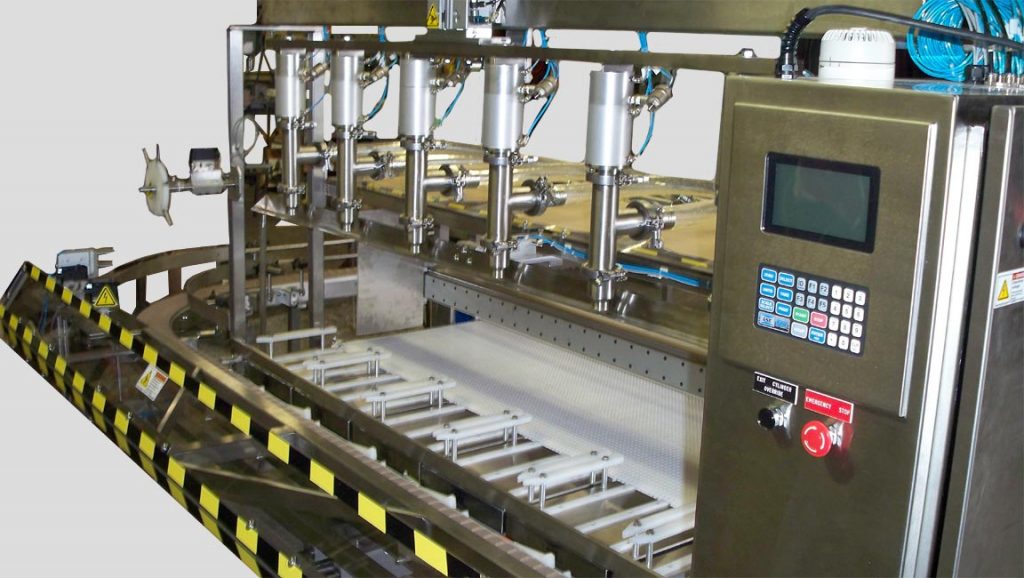
Automatic Net-Weight Gravimetric Chemical Filler
Ideal for bulk chemical packaging (1 Gallon to 55-Gallon Drums and IBC Tote containers). Utilizes high-precision strain-gauge load cells beneath each fill station to eliminate temperature-induced density filling errors.
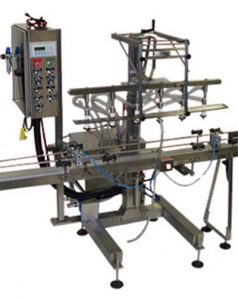
Corrosive-Acid Straight-Line Polypropylene Filler
Designed specifically for aggressive inorganic acids (HCl, H2SO4, Bleach) where zero metal exposure is permitted. Constructed completely with non-metallic heavy-gauge welded polypropylene structural framing.
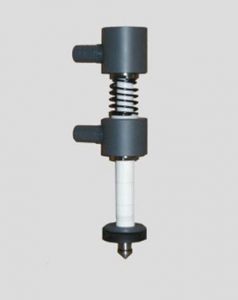
Explosion-Proof Solvent & Alcohol Piston Filler
Engineered for flammable solvents, thinners, and hydrocarbon fuels. Features full pneumatic actuation, Class 1 Division 1 intrinsically safe electrical components, and spark-free grounding contact points.
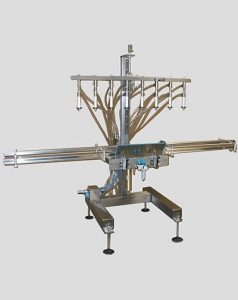
Heavy-Duty Semi-Automatic Chemical Benchtop Filler
Compact, highly flexible liquid filler engineered for low-volume specialty chemical batches, pilot plants, and laboratory dosing applications. Features rapid toolless strip-down and cleaning.
3. Critical Metallurgy, Polymers, & Elastomer Compatibility Matrix
Chemical corrosion is not uniform; it manifests as general wasting, crevice corrosion, intergranular attack, stress corrosion cracking (SCC), or pitting. Selecting the wrong material for chemical liquid filling machine components results in product contamination and unsafe equipment failure.
Filling Equipment Company, Inc. utilizes tailored metallurgy and polymer selection based on exact chemical concentrations, pH levels, and operational temperatures:
| Chemical Family | Example Fluids | Recommended Contact Metallurgy / Polymer | Elastomer / Seal Material | Prohibited Materials |
|---|---|---|---|---|
| Strong Inorganic Acids | Hydrochloric Acid (37%), Hydrofluoric Acid, Sulfuric Acid | Polypropylene, PVDF (Kynar), PTFE (Teflon), Hastelloy C-276 | FFKM (Kalrez), EPDM (Peroxide Cured) | 304/316L Stainless Steel, Brass, Viton |
| Chlorinated Solvents & Hydrocarbons | Methylene Chloride, Trichloroethylene, Toluene, Xylene | 316L Stainless Steel, Titanium Grade 2, PTFE | PTFE Encapsulated Viton, FFKM | Buna-N, Natural Rubber, Polyurethane, PVC |
| Oxidizing Reagents & Bleaches | Sodium Hypochlorite (15%), Hydrogen Peroxide (50%) | Titanium, PVC, PVDF, High-Density Polyethylene (HDPE) | Viton-B, PTFE, Silicone | Carbon Steel, 304 SS, Copper, Nylon |
| Viscous Lubricants & Resins | Synthetic Gear Oils, Polyurethane Resins, Epoxies | 316L Stainless Steel, Electroless Nickel Plated Tool Steel | Viton, FFKM, Metal-Filled PTFE | Unlined Polypropylene (due to structural flex) |
4. Hazardous Environment Engineering: Explosion-Proof & Fume Containment
Global chemical manufacturing facilities operating in North America, Europe, and Asia must comply with stringent workplace safety directives, including OSHA, NFPA 30, and ATEX/IECEx standards. Chemical liquid filling machines processing Class I, II, or III flammable fluids must incorporate comprehensive explosion mitigation architectures.
A. Class 1 Division 1 (C1D1) & Class 1 Division 2 (C1D2) Compliance
For environments where ignitable concentrations of flammable gases, vapors, or liquids exist under normal operating conditions (C1D1), electrical control panels are replaced with NEMA 7/9 cast-aluminum explosion-proof enclosures or pneumatic logic control systems. Drives are equipped with explosion-proof motors featuring sealed conduit fittings and positive-pressure Nitrogen (N2) purge systems. Spark-resistant alloys (such as beryllium-copper or bronze) are utilized for moving components that could strike container necks.
B. Sub-Surface Bottom-Up Nozzle Filling & Vapor Recovery
When filling liquid solvents, rapid top-filling creates droplets that generate electrostatic charges across the liquid surface, presenting a combustion hazard. Filling Equipment Company's chemical filling machines employ Bottom-Up Diving Nozzles. The filling nozzle lowers to the absolute bottom of the container before fluid flow commences. The nozzle then retracts in precise synchronicity with the liquid rise, keeping the nozzle tip submerged beneath the liquid level. This completely eliminates splashing, minimizes static charge generation, and reduces volatile organic compound (VOC) emissions by up to 90%.
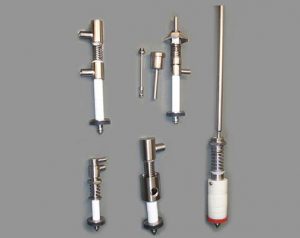
Custom engineered stainless steel and Hastelloy filling nozzles equipped with integrated vapor draw shrouds for dangerous chemical fluids.
5. Future Procurement Trends in Chemical Liquid Filling Machinery (2026–2035)
As global supply chains undergo rapid digital transformation and environmental regulations become tighter under EPA, REACH, and ESG mandates, purchasing officers and chemical plant engineers must evaluate equipment against long-term operational trends:
1. AI-Driven Coriolis Mass Flowmeter Calibration
Traditional volumetric piston fillers require manual mechanical adjustment when switching between chemical batches of varying viscosity or specific gravity. Next-generation chemical liquid filling machines integrate Coriolis Mass Flowmeters directly linked to edge-AI programmable logic controllers (PLCs). The system measures mass, density, and temperature simultaneously thousands of times per second, dynamically auto-adjusting valve opening duration to compensate for thermal expansion or batch variance without stopping the line.
2. Zero-Emission Closed-Loop Vapor Containment
Environmental standards increasingly demand closed-loop chemical transfers. Modern chemical filling equipment incorporates inflatable neck seals around the filling nozzle collar. During filling, displaced toxic vapors are actively routed through a dedicated vacuum return port connected to localized thermal oxidizers, wet scrubbers, or carbon adsorption units.
3. Modular Peristaltic & Single-Use Fluid Paths for Specialty Chemicals
For high-value agrochemicals, electronic-grade chemicals, and specialty reagents, cross-contamination clean-in-place (CIP) validation can consume hours of production time. The industry is moving toward modular, disposable, or rapid-exchange fluoropolymer fluid tubing paths powered by heavy-duty peristaltic drive pumps, completely separating the fluid from pump mechanical hardware.
6. Frequently Asked Questions (FAQ) — Global Buyer Intent & AI Query Analysis
7. Enterprise Advantage: Why Industry Leaders Trust Filling Equipment Company, Inc.
Choosing a chemical packaging equipment vendor is an investment in facility safety, regulatory compliance, and operational profitability. Since 1959, Filling Equipment Company, Inc. has established an unrivaled reputation in the global industrial machinery market.
- 65+ Years of Metallurgical & Mechanical Expertise: Established in 1959 in College Point, New York, our deep institutional knowledge guarantees every machine is engineered with absolute fluid compatibility.
- Direct Factory Engineering & Customization: We do not rebrand imported white-label machinery. All our automatic liquid filling machines, bottle capping equipment, and custom chemical nozzles are designed, machined, assembled, and tested directly in our U.S. facility.
- Uncompromising Safety Standards: From C1D1 explosion-proof electrical layouts to fully enclosed toxic fume scrubbers, our machinery meets strict OSHA, CE, and NFPA regulations.
- Comprehensive Lifetime After-Sales Support: We maintain complete engineering schematics and replacement component inventories for every machine built over the past six decades, ensuring minimal downtime for your processing plant.
Accelerate Your Chemical Packaging Operations Today
Speak directly with our senior fluid handling engineers. Receive a detailed technical evaluation and customized quote tailored to your exact chemical viscosity, container geometry, and throughput requirements.