
Technical Articles & Updates

Packaging & Liquid Filling Insights

Expert guides, machinery maintenance tips, and liquid packaging innovations from industry specialists since 1959.

Automation & Efficiency

Industry Trends & Buying Guides

In-depth analysis and technical advice for optimizing your liquid bottling and capping operations.

Solutions & Maintenance

Equipment Optimization Tips

Practical guides on nozzle selection, viscosity handling, and extending machine service life.

0%

Choosing a Semi Automatic Liquid Filling Machine requires more than comparing prices or advertised speeds. Product viscosity, container shape, fill volume, and cleaning time all affect real performance. A thick lotion may need a piston filler, while a free-flowing solution may suit a gravity or peristaltic system. Watch the nozzle. A few extra drops can become significant product loss across thousands of bottles.

Industry data supports careful equipment selection. PMMI’s 2024 packaging machinery outlook reports continued investment in automation, driven by labor shortages, product variation, and efficiency goals. Grand View Research also identifies liquid packaging as a growing market, with demand shaped by pharmaceuticals, food, cosmetics, and household products. These reports indicate opportunity, but they do not guarantee that every machine fits every application.

John R. Henry, author of The Packaging Machinery Handbook, offers a useful principle: “The machine must be selected for the product, package, and production requirement.” That advice remains practical. Ask for trials using your actual liquid, bottle, cap, and target volume. Measure accuracy after repeated cycles, not after one successful test. Check whether operators can adjust the machine without specialized tools. Small details matter.

The wrong choice can look efficient on paper. It may still create foaming, dripping, downtime, or difficult cleaning. A semi-automatic system also depends heavily on operator consistency. That weakness deserves attention. Review maintenance access, spare-part availability, safety features, and future capacity before purchasing. The best Semi Automatic Liquid Filling Machine is not always the fastest model. It is the one that delivers repeatable fills, manageable operation, and credible long-term support.
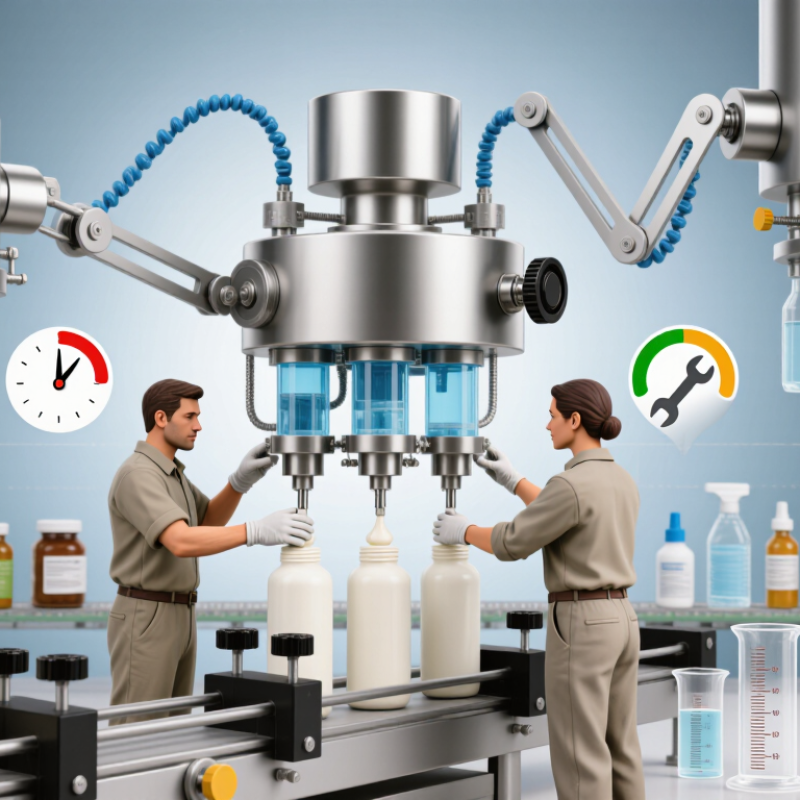
7 Tips for Choosing a Semi Automatic Liquid Filling Machine

Define Your Filling Requirements and Product Characteristics

Choosing a semi automatic liquid filling machine starts with the product, not the machine frame. Record viscosity, foaming, temperature, particles, and chemical compatibility. A thin sanitizer-like liquid may need time-based filling, while a thick syrup may require a piston system. Product density can also change with temperature. Small details matter.

Measure the target fill range and acceptable tolerance. A 50-milliliter bottle needs different control from a five-liter container. Note container shape, neck size, material, and daily volume. PMMI’s 2024 State of the Industry report identifies labor availability and equipment efficiency as continuing packaging challenges. A semi automatic filler can reduce repetitive work, but it still depends heavily on operator consistency. That weakness is easy to underestimate.

Ask for real production trials using your liquid and containers. Check the filling speed, drip control, cleaning time, and changeover steps. Grand View Research describes liquid packaging as a multi-billion-dollar global market, with growth linked to convenience and process efficiency. That growth does not make every machine suitable. A machine that fills accurately in a supplier’s test room may perform differently beside a warm mixing tank. I have seen teams focus on advertised speed and ignore nozzle height. It was an expensive lesson. Define the product’s worst-case behavior, not only its ideal sample. Include washdown conditions, available air pressure, and the operator’s actual skill level. Leave room for honest uncertainty.

7 Tips for Choosing a Semi-Automatic Liquid Filling Machine

Define Your Filling Requirements and Product Characteristics

Product viscosity is a key factor when selecting a semi-automatic liquid filler. Low-viscosity liquids such as water generally flow easily through standard nozzles, while shampoos, honey, and lotions may require slower filling speeds, larger passages, stronger pumps, or piston-based systems. The values shown are representative viscosity levels at approximately room temperature; actual viscosity varies with formulation and temperature.

Compare Machine Capacity, Accuracy, and Filling Speed

Choosing a semi automatic liquid filling machine requires more than checking its advertised output.

Compare capacity, accuracy, and filling speed under real working conditions.

Tip 1: Match the hopper capacity to your batch size.

A small hopper may require frequent refilling, while an oversized hopper can waste space and material.

Tip 2: Test the machine with your actual liquid.

Water-like products may fill quickly, but thick liquids often need slower cycles and stronger control.

Tip 3: Ask for a measurable accuracy range.

A small error becomes expensive across hundreds of containers.

In filling trials, record the weight of several samples, not just one.

Tip 4: Compare practical speed, not the highest stated speed.

Container size, operator movement, and nozzle adjustment all affect output.

A faster setting is not always better. It can create splashing, foam, or inconsistent levels.

Tip 5: Check whether the machine handles different volumes without difficult changes.

Clear markings and simple controls save time during production.

My first comparison focused too much on speed; that was a mistake.

Tip 6: Review cleaning access carefully.

Product residue around valves or nozzles can affect the next batch.

Tip 7: Request a live demonstration using your container shape and liquid viscosity.

Measure filling time, sample variation, and operator effort.

A machine that looks efficient in a brochure may perform differently on a busy workbench.

Keep written test results before making the final decision.

Evaluate Compatibility with Containers and Materials

Evaluate Compatibility with Containers and Materials

Container compatibility is not a checkbox; it is a production risk. PMMI’s 2023 State of the Industry report recorded U.S. packaging machinery shipments at $10.2 billion in 2022. That investment makes incorrect equipment selection expensive.

Test the actual container, not a sample photograph. Check neck diameter, height, wall thickness, rigidity, and surface finish. A thin bottle may collapse under a fast filling nozzle. A narrow opening may create splashing, foam, or inaccurate volume. Glass, PET, HDPE, and flexible pouches also react differently during filling.

Material behavior matters just as much. High-viscosity liquids may require larger valves, slower speeds, or bottom-up filling. Foaming products often need diving nozzles and adjustable flow control. Abrasive or corrosive formulas demand compatible wetted parts. Smithers’ 2024 packaging outlook highlights continued growth in flexible and recyclable formats through 2028. Your machine should handle today’s container, but also likely format changes.

Ask suppliers for trials using your product, container, and target fill volume. Measure accuracy across repeated cycles. I would not trust one successful test. It can hide temperature changes, settling, or inconsistent bottle dimensions. Record the results, including cleaning time and material waste. Compatibility is proven on the production floor, not in a brochure.

Review Operation, Cleaning, Maintenance, and Safety Features

Choosing a semi automatic liquid filling machine starts with observing daily operation, not trusting brochure claims. During a trial, check whether operators can adjust fill volume, nozzle height, and foot-pedal timing easily. Controls should remain clear while wearing gloves. Run containers with different liquid viscosities. Watch for dripping, splashing, and uneven levels. Small errors become costly during long shifts. A short test matters.

Cleaning must fit the real production routine. Ask whether product-contact parts can be removed without special tools. Inspect seals, hoses, and nozzles under bright light. Smooth stainless surfaces reduce residue, but they do not replace careful cleaning. Follow documented cleaning agents, rinsing steps, and drying times. Never assume a visual rinse is sufficient. I once treated a nearly clear line as clean and later found residue near a gasket. That mistake changed how I verify sanitation. Keep records with dates, operators, and observations.

Maintenance features should make wear visible before failure. Look for accessible lubrication points, replaceable seals, calibration checks, and clear service instructions. A fill-volume test using a scale can reveal drift early. Safety deserves equal attention. Emergency stops, guarded moving parts, stable frames, and restart protection reduce avoidable injuries. Confirm that the machine stops when a guard opens, where applicable. Train operators to isolate power before servicing. Good equipment supports safe habits, but it cannot correct rushed work or skipped inspections. Leave room for improvement.

Assess Supplier Support, Cost, and Long-Term Value

Choosing a semi automatic liquid filling machine requires more than comparing product prices. In production trials, supplier support often determines whether the machine performs consistently. Ask about installation guidance, operator training, and response times for technical questions. Request a written service process before purchasing. Ask for proof. Check whether spare parts are stocked locally and whether manuals include clear cleaning and adjustment steps. A short video call with an engineer can reveal practical knowledge that a sales sheet cannot.

Purchase cost is only one part of the investment. Calculate tooling, shipping, installation, maintenance, electricity, and expected downtime. Ask how easily the machine handles different bottle sizes and liquid viscosities. A flexible machine may cost more initially but reduce future replacement costs. However, flexibility can be overstated. Test your actual liquid, container, and target fill volume before signing an order.

Long-term value depends on stable accuracy and manageable maintenance. Request sample filling records, calibration procedures, and recommended service intervals. Examine contact parts for smooth surfaces and easy removal. Ask whether common seals, hoses, and valves can be replaced without specialist tools. I once underestimated cleaning time, and the lost production affected the real payback period. That mistake changed how I assess equipment. Choose a supplier willing to discuss limitations, not only advantages. Confirm warranty coverage, software or control updates, and future technical support in writing.

7 Tips for Choosing a Semi Automatic Liquid Filling Machine - Assess Supplier Support, Cost, and Long-Term Value

No. Selection Tip What to Assess Useful Technical Benchmark How to Verify Before Purchase Long-Term Value Indicator
1 Match the filling principle to the liquid Check viscosity, foaming tendency, particle content, temperature, and chemical compatibility. Time-gravity, piston, peristaltic, and gear-pump systems are suited to different liquid characteristics. Request the machine's operating viscosity range in mPa·s (cP). Water is approximately 1 mPa·s at 20°C, while many oils, creams, and syrups are substantially more viscous. Send representative product samples and require a recorded test using the actual bottle, cap, liquid temperature, and target fill volume. A correctly matched filling method reduces inconsistent fills, foaming, dripping, pump wear, and product waste.
2 Confirm accuracy and repeatability Evaluate filling accuracy at the minimum, nominal, and maximum target volumes rather than relying only on a single advertised tolerance. For many semi-automatic liquid fillers, a commonly stated accuracy range is approximately ±0.5% to ±1%, but actual performance depends on liquid properties, volume, temperature, and calibration. Ask for a documented trial with at least 10 consecutive fills. Weigh each filled container and review the average, range, and standard deviation. Better repeatability lowers giveaway product and helps maintain consistent net contents during production.
3 Check throughput against real operator workflow Consider filling time, container placement, nozzle movement, foot-pedal operation, changeover, cleaning, and the time needed to inspect and remove filled containers. Advertised output is often expressed as fills per minute. Practical output is usually lower because it includes manual container handling and product adjustments. Calculate output using the actual number of nozzles, fill volume, container size, operator count, and required daily production hours. A machine that fits the real workflow is more valuable than a faster machine that creates bottlenecks at loading, capping, or labeling.
4 Inspect wetted-part materials and cleanability Review all product-contact parts, seals, hoses, valves, and nozzles for compatibility with the liquid, cleaning agents, and required hygiene level. 304 stainless steel is widely used for general food and industrial applications; 316 stainless steel offers improved resistance to chlorides and some corrosive environments. Material suitability must be confirmed for the specific product. Request a wetted-parts list, seal-material specification, disassembly procedure, cleaning instructions, and information about tool-free components. Corrosion-resistant, easily removable parts can reduce contamination risk, cleaning labor, downtime, and replacement frequency.
5 Evaluate supplier testing, training, and service support Assess response time, installation guidance, operating manuals, troubleshooting support, remote assistance, technician availability, and operator training. Require written service commitments, including support channels, normal response times, warranty coverage, and the scope of commissioning assistance. Ask for a sample manual, maintenance schedule, troubleshooting guide, training agenda, and a clear process for handling warranty claims. Accessible technical support can shorten downtime and reduce the risk of incorrect setup or maintenance.
6 Compare total cost of ownership, not purchase price alone Include the machine price, freight, installation, tooling, spare parts, cleaning supplies, calibration, labor, electricity, downtime, and future upgrades. Request a three- to five-year ownership estimate with separate line items for consumables, preventive maintenance, replacement seals, pumps, valves, and controls. Compare at least three equivalent quotations using the same specifications, fill range, materials, testing requirements, warranty terms, and included accessories. A lower initial price may become more expensive if parts are proprietary, service is slow, or changeover and cleaning take excessive time.
7 Plan for growth, flexibility, and spare-parts availability Check whether the machine can handle planned product variations, additional container sizes, multiple fill volumes, extra nozzles, and future production increases. Confirm the adjustment range for fill volume, nozzle spacing, container dimensions, electrical requirements, and the availability period for critical replacement parts. Obtain a recommended spare-parts list, lead times, part numbers, wiring diagrams, and a written statement about compatibility with future accessories. Modular equipment can delay a full replacement when product lines, container formats, or production volumes change.

Note: Performance ranges are general industry guidelines rather than guarantees. Actual results should be confirmed through a documented factory acceptance test using the intended liquid, container, fill volume, and operating conditions.

FAQS

How should hopper capacity match the batch size?

Choose a hopper that fits your normal batch. A small hopper needs frequent refilling. An oversized hopper wastes workspace and material. Measure your actual batch volume before deciding.

Does liquid thickness affect filling speed?

Yes. Water-like liquids usually fill quickly. Thick liquids need slower cycles and stronger control. Test the real product, not plain water. Record filling time and operator effort.

How can filling accuracy be checked?

Request a measurable accuracy range. Fill several containers and weigh each sample. One sample is not enough. Small errors become costly across hundreds of containers. Results may vary more than expected.

Is the highest advertised speed reliable?

Not always. Container size, operator movement, and nozzle adjustment affect output. Excessive speed can cause splashing, foam, or uneven levels. Practical speed matters more. I once focused too much on speed.

Can one machine handle different container sizes?

Ask how easily volumes and containers can change. Clear markings and simple controls reduce setup time. Test several container shapes. Difficult adjustments may erase the benefit of higher speed.

Why is cleaning access important?

Residue can remain around valves and nozzles. It may affect the next batch. Check whether contact parts are smooth and easy to remove. Cleaning time is easy to underestimate.

What supplier support should be confirmed?

Ask about installation guidance, operator training, and technical response times. Request the service process in writing. Check spare-part availability and manual clarity. A short engineer video call can reveal practical knowledge.

How should the total investment be calculated?

Include purchase cost, tooling, shipping, installation, maintenance, electricity, and downtime. Flexible equipment may reduce future replacement costs. Still, flexibility can be overstated. Test your liquid and containers before ordering.

What proves long-term value?

Request filling records, calibration procedures, and service intervals. Check whether seals, hoses, and valves need specialist tools. Confirm warranty coverage and future technical support in writing. Payback may look different after cleaning delays.

Conclusion

Choosing the right Semi Automatic Liquid Filling Machine begins with a clear understanding of your product and filling requirements. Consider the liquid’s viscosity, temperature, foaming behavior, and particle content, as well as the desired fill volume and production scale. Compare each machine’s capacity, filling accuracy, speed, and adjustment range to ensure it can meet both current and future needs. Container compatibility is also essential, so verify that the equipment can handle your container shapes, sizes, and materials without causing spills or inconsistencies.

Practical operation and long-term reliability should also guide your decision. Look for intuitive controls, easy cleaning, accessible maintenance points, and suitable safety features. Finally, evaluate supplier support, warranty terms, spare-part availability, installation guidance, and total operating costs. A machine with a reasonable purchase price may not provide the best value if it requires frequent repairs or complicated upkeep. By balancing performance, compatibility, usability, support, and overall cost, you can select equipment that improves efficiency and delivers consistent filling results.

Ethan

Ethan

Ethan is a seasoned marketing professional with a deep knowledge of the company's product offerings. With years of experience in the industry, he brings a unique perspective to the team, consistently demonstrating his expertise through detailed blog posts that are published on the company website.......