
Technical Articles & Updates

Packaging & Liquid Filling Insights

Expert guides, machinery maintenance tips, and liquid packaging innovations from industry specialists since 1959.

Automation & Efficiency

Industry Trends & Buying Guides

In-depth analysis and technical advice for optimizing your liquid bottling and capping operations.

Solutions & Maintenance

Equipment Optimization Tips

Practical guides on nozzle selection, viscosity handling, and extending machine service life.

0%

Choosing Wine and Liquor Fillers is not simply a matter of selecting the fastest machine. The right filler must protect flavor, control oxygen exposure, and handle each bottle with steady precision. A delicate Pinot Noir may need different treatment from a high-proof spirit. Bottle shape, viscosity, closure type, production volume, and cleaning requirements all deserve close attention.

According to beverage-processing consultant Maria Chen, “A filler should protect the product before it protects the production rate.” This principle is easy to overlook. A fast machine can still create foam, inconsistent levels, or unnecessary product loss. Those small failures become expensive when thousands of bottles move through the line. Watch the fill valve, not only the sales brochure. Look for clean shutoff, stable liquid levels, and gentle bottle handling.

Reliable Wine and Liquor Fillers should also support hygienic operation and documented quality checks. Ask how the system manages changeovers between bottle formats. Examine the contact materials carefully. Stainless steel may sound sufficient, but the entire product path requires evaluation. Temperature control matters too. Some spirits flow easily, while thicker wine products may need a different filling method.

There is no perfect filler for every facility. That is the uncomfortable part. A smaller producer may value flexibility over maximum speed, while a large plant may prioritize automation and repeatability. Technical advice helps, but real bottle trials reveal more than promises. Test the equipment with your own liquid, bottle, and closure. Then question the results before signing.
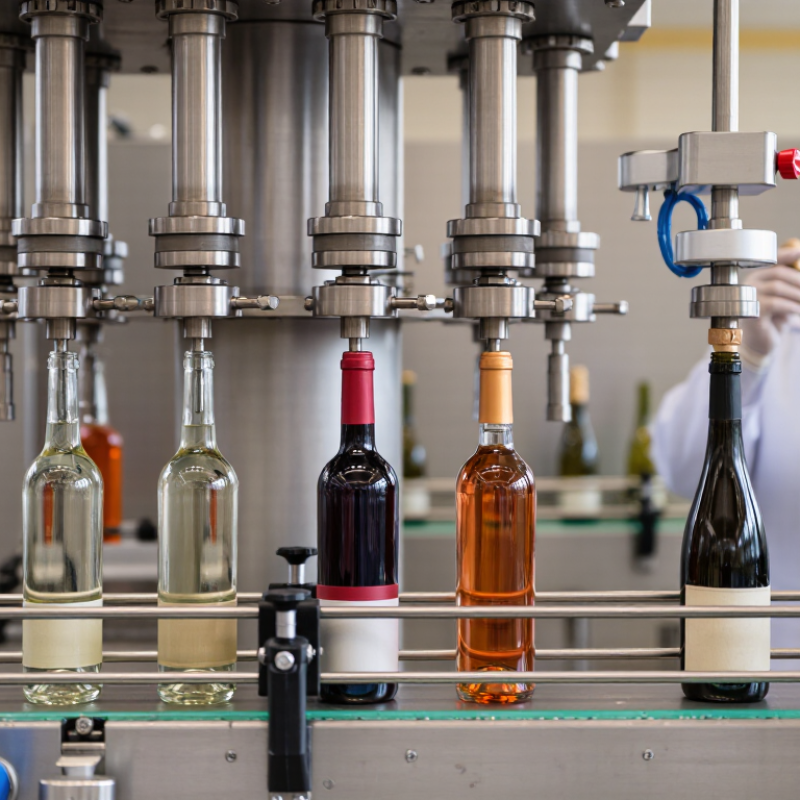
How to Choose Wine and Liquor Fillers?

Define Bottle Size, Product Viscosity, and Target Throughput

How to Choose Wine and Liquor Fillers?

Bottle size is the first practical decision. A 375 ml bottle needs different timing than a 1.5-liter format. Neck diameter, closure design, and headspace also affect filling accuracy.

The OIV reported global wine production at approximately 237 million hectoliters in 2023, the lowest level in more than 60 years.

This volatility makes flexible equipment valuable. A filler should support planned sizes without excessive changeover time.

Product viscosity can change with temperature, sugar content, and alcohol level. Water-like spirits may suit gravity or pressure filling. Thicker liqueurs often require positive-displacement pumps and wider product paths.

Measure viscosity at the actual filling temperature. A laboratory result at 20°C may mislead operators on a cold production floor.

Product foaming also matters. Slower filling can protect the appearance, but it reduces output.

Target throughput should be calculated from real operating conditions, not catalog speed. For example, 3,000 bottles per hour equals 50 bottles per minute before stoppages. Add time for cleaning, bottle changes, inspections, and minor jams.

PMMI’s Beverage Trends in Packaging and Processing research highlights flexibility, automation, and efficient changeovers as important packaging priorities. A 2024 IWSR market analysis also shows continued variation across beverage categories, making adaptable lines a safer investment.

The first trial may disappoint. That is useful. Record fill variance, drip loss, foam, and recovery time before choosing the final filler.

Match Filler Types to 750 mL Wine and 700 mL Spirit Bottles

Choosing a filler starts with the bottle, not the liquid alone. A standard 750 mL wine bottle often suits a gravity or vacuum filler. These systems handle low-viscosity wine gently and help limit foaming. Check the neck finish carefully. Small differences can affect sealing and fill accuracy.

For 700 mL spirit bottles, a piston or level-overflow filler may offer better control. Piston systems manage measured volumes, while overflow fillers create a consistent liquid level. This matters when clear spirits must look uniform on the shelf. Higher alcohol content can also challenge seals and tubing. Use materials rated for the product and cleaning process.

Bottle volume is only a starting point. Glass thickness, shoulder shape, and internal height may change the actual fill point. I measure several empty bottles before adjusting the machine. Then I test filled bottles after they rest. Temperature changes can alter liquid volume. A perfect first run is not guaranteed. That is worth remembering.

During setup, verify the 750 mL wine setting and the 700 mL spirit setting separately. Record fill weights, foam behavior, drip loss, and headspace. Keep the line clean and inspect valves between products. If a filler saves time but creates uneven levels, it is not the better choice. Practical trials reveal more than a specification sheet.

How to Choose Wine and Liquor Fillers?

Matching filler types to 750 mL wine and 700 mL spirit bottles

How to read the chart: 750 mL is a common nominal size for wine bottles, while 700 mL is a common nominal size for spirit bottles in many markets. Overflow and gravity fillers are commonly considered for free-flowing still wine. Gravity or flowmeter-based systems are commonly considered for free-flowing spirits when controlled volume measurement is required.

The final filler selection should also consider viscosity, foaming, particulates, bottle shape, production speed, cleaning requirements, and the required fill-level or volumetric accuracy. The values shown are nominal package volumes, not machine capacity limits.

Set a ±0.5% Fill-Accuracy Benchmark for High-Value Liquids

How to Choose Wine and Liquor Fillers?

Set a ±0.5% fill-accuracy benchmark before comparing filling equipment. For a 750 ml bottle, this allows only 3.75 ml above or below target. Across 10,000 bottles, that difference reaches 37.5 litres. The OIV’s State of the World Vine and Wine Sector 2024 estimated global wine production at 225.8 million hectolitres. Small losses can therefore become expensive quickly. Gravimetric fillers suit high-value liquids because weighing verifies every dose. Flowmeter systems can also perform well, but temperature, viscosity, foam, and bottle shape require careful validation. Test accuracy at real production speed, not only during a slow demonstration.

Tips: Record fill weight, liquid temperature, line speed, and nozzle position. Repeat the test across several batches. A ±0.5% result may look impressive, yet it can fail when the liquid warms or foams. That is the uncomfortable part. Choose equipment with adjustable nozzles, stable product handling, and data logging. NIST Handbook 44 emphasizes traceable measurement and suitable verification procedures for commercial weighing. Use calibrated scales and documented checks before approving a filler. Consider cleaning time too. A machine that fills accurately but causes long stoppages may reduce practical output. Review both average accuracy and variation between bottles. The average can hide weak control. Then challenge the supplier to show results using your actual container, closure, and liquid.

Compare Gravity, Vacuum, Overflow, and Piston Filling Systems

How to Choose Wine and Liquor Fillers?

Compare Gravity, Vacuum, Overflow, and Piston Filling Systems

Choosing a filler starts with the liquid, not the machine. Gravity filling suits still wine and low-viscosity liquids with stable flow. It is gentle, simple, and relatively easy to maintain. However, fill levels may vary when product temperature changes. Vacuum filling removes air from the bottle before filling. This can help delicate wine flow smoothly and reduce splashing. It also works well with narrow bottle openings, but seals and vacuum settings require regular inspection. Small leaks can create inconsistent results.

Overflow filling creates a consistent liquid level, even when bottle capacity varies slightly. It is useful for clear bottles where shelf appearance matters. The system may foam with some wines or spirits, so testing is essential. Piston filling handles thicker liquids and precise volumes effectively. It offers strong control, but moving parts need careful cleaning and calibration. For thin products, it may add unnecessary complexity.

Tips: Test the actual liquid, bottle, closure, and production speed together. Measure temperature, foam, drip behavior, and fill accuracy. Use food-contact materials and keep inspection records. An experienced operator should watch the first production run closely. No method is perfect. A filler that performs well in a warm trial may behave differently during a cool morning shift. That detail is easy to overlook. When uncertain, run several small trials before choosing a final system.

How to Choose Wine and Liquor Fillers? - Compare Gravity, Vacuum, Overflow, and Piston Filling Systems

Comparison Dimension Gravity Filler Vacuum Filler Overflow Filler Piston Filler
Basic operating principle Liquid flows from an elevated tank into containers under gravity. A vacuum draws liquid into containers, usually through a filling tube. Liquid enters until it reaches the overflow port, producing a consistent visible level. A measured piston stroke displaces a defined volume of liquid into each container.
Best suited wine or liquor applications Still wine, low-viscosity spirits, and simple products with stable flow behavior. Still wine, spirits, and bottles that need filling with reduced air exposure. Clear wine and spirits where a uniform bottle appearance is important. Higher-viscosity liqueurs, cream liqueurs, flavored products, and small production runs.
Typical product viscosity range Low viscosity; commonly used for water-like liquids. Low to moderately low viscosity; performance depends on vacuum level and product aeration. Low viscosity and free-flowing liquids provide the most stable results. Low to high viscosity, depending on piston diameter, valve design, and product temperature.
Fill-volume control Controlled mainly by filling time, liquid level, pressure, and container geometry. Controlled by vacuum conditions, filling time, and container dimensions. Controlled primarily by the overflow level and the container neck or opening. Controlled directly by piston stroke volume; recipes can usually be adjusted digitally or mechanically.
Typical dosing consistency Moderate; affected by liquid level, temperature, and product flow characteristics. Moderate to good when bottle dimensions and vacuum conditions are consistent. Good visual fill-level consistency, but the delivered volume can vary with bottle capacity and internal geometry. Good to very good volumetric consistency when correctly calibrated and operated.
Bottle appearance May show different liquid levels if bottle internal capacity varies. Generally acceptable, but the final level may vary with bottle geometry. Excellent uniformity of visible liquid level across bottles of consistent design. Consistent volume, although the visible level can differ when bottle capacity or shape varies.
Foaming and product agitation Usually gentle, but excessive drop height can cause splashing or aeration. Can reduce trapped air, but excessive vacuum may increase bubbling in some products. Can create recirculation and foaming if flow rate, venting, or nozzle settings are unsuitable. Can be gentle when speed is controlled; fast piston movement may shear or foam sensitive products.
Oxygen-management potential Limited unless combined with low-drop filling, inert-gas blanketing, or bottom-up filling. Potentially good because air can be removed during filling; actual results depend on the complete process. Moderate; overflow and recirculation may increase product contact with air if not properly controlled. Moderate to good when paired with submerged nozzles, closed product paths, and inert-gas purging.
Handling particulates or sediment Limited; sediment may settle in the tank or restrict small filling passages. Limited; particles can interfere with valves, tubes, and vacuum flow. Limited to moderate, depending on nozzle and valve clearance. Moderate when equipped with suitable large-passages valves; large particles may still require specialized equipment.
Changeover flexibility High for simple products; changes in bottle height may require nozzle or conveyor adjustment. Moderate; bottle necks, vacuum settings, and filling tubes may need adjustment. Moderate; overflow tubes and bottle supports must match the container format. High; fill volume can be changed without changing the basic filling principle, although pistons or seals may need replacement for major viscosity changes.
Cleaning and sanitation Generally simple because the system has few moving parts and a straightforward product path. Requires cleaning of product tubes, valves, vacuum chambers, and any recovery lines. Requires careful cleaning of overflow channels and return lines to prevent residue buildup. Requires thorough cleaning of pistons, cylinders, seals, valves, and product manifolds.
Equipment complexity Low. Moderate because of the vacuum pump, chamber, controls, and seals. Moderate because of overflow circuits, return systems, and level-control components. Moderate to high because of cylinders, valves, actuators, controls, and wear components.
Relative investment level Low to moderate. Moderate. Moderate. Moderate to high, especially for automated multi-head systems.
Speed potential Suitable for low to medium throughput; speed is limited by gravity flow and drip control. Suitable for low to medium throughput; vacuum performance and bottle sealing affect cycle time. Suitable for medium to high throughput when bottles and product flow are consistent. Suitable for low to high throughput, depending on the number of filling heads and product viscosity.
Main advantages Simple design, low maintenance, gentle handling, and economical operation. Can help remove air and can fill certain bottles efficiently with a controlled vacuum. Produces a highly uniform visible fill level and works well with clear products. Accurate volumetric dosing, broad viscosity capability, and strong recipe flexibility.
Main limitations Less precise when product temperature, tank level, or bottle capacity changes. More components to maintain; vacuum performance can be affected by leaks, foam, or unsuitable bottle closures. Requires product recovery and careful control of foaming, drainage, and overflow sanitation. Higher cost and more cleaning and maintenance; seals and pistons are wear items.

Note: Actual filling accuracy, speed, and product compatibility depend on liquid temperature, viscosity, dissolved gas, bottle geometry, nozzle design, filling-head count, and machine settings. Equipment should be validated with the specific wine, liquor, bottle, and closure combination.

Check CIP, FDA 21 CFR, and 3-A Sanitary Design Compliance

How to Choose Wine and Liquor Fillers?

A filler should protect product safety, not only increase bottles per minute. The OIV’s State of the World Vine and Wine Sector in 2024 estimated 2023 global wine production at 237 million hectolitres. At this scale, poor cleaning can create costly recalls, waste, and downtime. Choose equipment with documented CIP performance, including time, temperature, chemical concentration, flow, and final rinse conductivity.

Check FDA 21 CFR requirements for hygienic manufacturing and food-contact materials. A supplier should provide material declarations, weld specifications, elastomer details, and cleaning validation records. 3-A Sanitary Design principles offer another useful benchmark. Look for drainable product paths, polished welds, accessible seals, minimal dead legs, and no hidden product traps. A shiny filler is not proof of hygiene. I still treat the first validation run as a question, not a victory. Confirm spray coverage and repeat testing after maintenance.

Tips: Request a complete CIP recipe before purchase. Ask for measured flow rates, not general claims. Review the filler’s 21 CFR documentation with your quality team. If 3-A certification is not available, require a clear sanitary-design assessment. Keep one retained swab plan for difficult areas, especially valve seats and transfer connections. Also, check changeover time with your own bottle formats; factory demonstrations can look easier than production reality. Industry reports often show efficiency gains, but sanitation failures can erase them quickly.

FAQS

What fill-accuracy target should be set for high-value liquids?

Set a benchmark of ±0.5% before comparing equipment. For a 750 ml bottle, this allows only 3.75 ml of variation. Across 10,000 bottles, the difference can reach 37.5 litres.

Which filling system suits still wine and other thin liquids?

Gravity filling often suits still wine and low-viscosity liquids. It is gentle and relatively simple to maintain. However, temperature changes may affect fill levels.

When is vacuum filling useful?

Vacuum filling removes air before the liquid enters the bottle. It can reduce splashing and help with narrow openings. Inspect seals regularly. Small leaks cause uneven results.

Why choose overflow filling?

Overflow filling creates a consistent visible liquid level. It works well when bottle capacity varies slightly. Foam may appear with some liquids, so test the actual product.

When is piston filling a better option?

Piston filling provides strong volume control for thicker liquids. It can handle precise doses effectively. Moving parts require careful cleaning and calibration. For thin liquids, it may be excessive.

How should filling accuracy be tested?

Test the real liquid, bottle, closure, and production speed together. Record fill weight, temperature, line speed, and nozzle position. Repeat testing across several batches. Slow demonstrations can mislead.

What hygiene features should a filler include?

Product paths should drain fully and contain few hidden spaces. Look for polished welds, accessible seals, and minimal dead legs. Food-contact materials need documented specifications. A shiny surface proves little.

What should be included in a cleaning validation?

Record cleaning time, temperature, chemical concentration, flow rate, and final-rinse conductivity. Check spray coverage around valve seats and transfer connections. Retain swab results from difficult areas. Maintenance can change cleaning performance.

How can equipment performance be judged beyond average accuracy?

Review both average accuracy and bottle-to-bottle variation. An attractive average can hide weak control. Also measure changeover time and stoppages. Accurate equipment is not automatically productive.

What should be requested from a supplier before purchase?

Request test data using your actual bottle, closure, liquid, and line speed. Ask for cleaning recipes, material declarations, weld details, and validation records. Run several small trials when uncertain. I might still overlook a cold-shift problem.

Conclusion

Choosing the right Wine and Liquor Fillers starts with clearly defining the bottle size, liquid viscosity, and required production speed. For standard 750 mL wine bottles and 700 mL spirit bottles, the filling system should be selected according to the product’s flow characteristics and the desired output. Gravity fillers may suit free-flowing liquids, while vacuum, overflow, or piston systems can provide better control for different viscosities and bottle designs. The goal is to achieve consistent filling performance without damaging the product or creating unnecessary waste.

For high-value wines and spirits, a fill-accuracy benchmark of ±0.5% is a practical quality target. Equipment should also support efficient cleaning and reliable sanitation procedures, including suitable CIP functionality. Before purchase, confirm that the machine’s materials, construction, and operating processes align with applicable FDA 21 CFR requirements and 3-A sanitary design principles. A balanced evaluation of accuracy, speed, flexibility, maintenance, and compliance will help ensure dependable long-term filling operations.

Ethan

Ethan

Ethan is a seasoned marketing professional with a deep knowledge of the company's product offerings. With years of experience in the industry, he brings a unique perspective to the team, consistently demonstrating his expertise through detailed blog posts that are published on the company website.......