
Packaging & Liquid Filling Insights
Expert guides, machinery maintenance tips, and liquid packaging innovations from industry specialists since 1959.
Industry Trends & Buying Guides
In-depth analysis and technical advice for optimizing your liquid bottling and capping operations.
Equipment Optimization Tips
Practical guides on nozzle selection, viscosity handling, and extending machine service life.
Top 10 Edible Oil Filling Machine Manufacturers Worldwide
Table of Contents
- Edible Oil Filling Machines: Definition, Types, and Operating Principles
- How to Evaluate Global Edible Oil Filling Machine Manufacturers
- Top 10 Edible Oil Filling Machine Manufacturers Worldwide
- Key Technologies and Features of Modern Oil Filling Equipment
- Industry Applications, Selection Factors, and Future Developments
- FAQS
- Conclusion
- Related Posts
The global edible oil sector is expanding, but filling technology is becoming more demanding. Bottles now range from compact household containers to large food-service jugs. Each format requires accurate dosing, stable capping, and clean product handling.
The Grand View Research report, Edible Oil Market Size, Share & Trends Analysis, identifies continued growth in packaged edible oils across emerging and established markets. Its findings point to stronger demand for convenient, hygienic, and traceable packaging. Meanwhile, PMMI’s Global Trends in Packaging and Processing Machinery report highlights automation, flexible production, and data visibility as major equipment priorities. These trends directly influence the selection of an Edible Oil Filling Machine.
This guide examines ten manufacturers serving international markets. The comparison considers filling accuracy, throughput, oil compatibility, changeover time, sanitation design, controls, and after-sales support. It also reviews whether suppliers can handle products such as olive oil, sunflower oil, soybean oil, and blended cooking oils.
Numbers can mislead.
A machine rated at 6,000 bottles per hour may perform differently under real factory conditions. Oil viscosity, bottle shape, temperature, operator skill, and cleaning routines all affect output. Buyers should request factory trials, documented tolerances, spare-parts plans, and references from comparable plants. ISO-based quality systems and applicable food-contact requirements also deserve careful verification.
No ranking is flawless. Manufacturer capabilities change, regional service quality varies, and published specifications may describe ideal conditions. Therefore, this list is intended as a practical starting point, not a substitute for technical validation. Reliable purchasing decisions come from comparing evidence, observing equipment performance, and matching the machine to the production line.
Edible Oil Filling Machines: Definition, Types, and Operating Principles
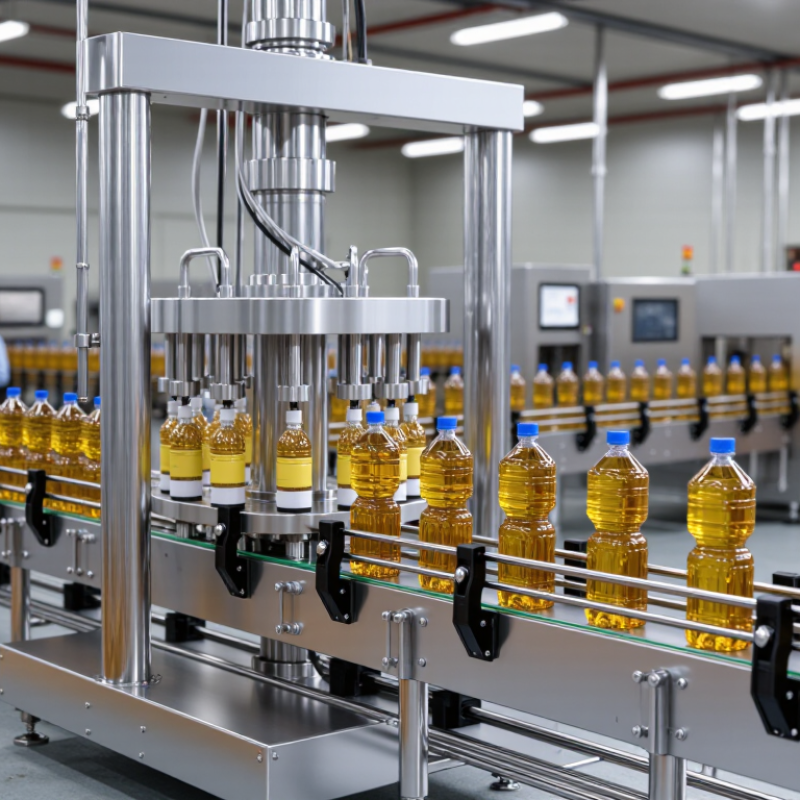
Edible oil filling machines are industrial systems that measure and transfer cooking oils into bottles, jars, pouches, or containers. They support consistent volume, cleaner production, and faster packaging. USDA’s Oilseeds: World Markets and Trade report for 2024/25 projects global vegetable-oil production above 220 million metric tons. That scale creates strong demand for accurate filling equipment.
Common types include gravity, piston, flowmeter, and net-weight fillers. Gravity systems suit thin oils and simple formats. Piston fillers handle thicker products, including some blended oils. Flowmeter machines provide electronic measurement and flexible recipe control. Net-weight fillers measure the actual product mass, which can reduce giveaway. Small details matter. A warm filling line may change viscosity and affect accuracy.
During operation, containers enter through a conveyor and stop beneath filling nozzles. A pump or product tank supplies oil at controlled pressure. Sensors confirm container position, while valves open for a timed, volumetric, or weight-based fill. Anti-drip nozzles help protect caps and labels from oily residue. CIP-compatible product paths also support hygienic maintenance. PMMI packaging reports consistently identify automation, traceability, and labor efficiency as major equipment priorities. Still, automation is not a cure-all. Poor calibration, unstable oil temperature, or foaming can reduce performance. Operators must verify fill weights regularly, record adjustments, and inspect seals, nozzles, and filters. That practical discipline is easy to underestimate.
How to Evaluate Global Edible Oil Filling Machine Manufacturers
Global edible oil production exceeds 200 million tonnes annually, according to the FAO Food Outlook 2024. This scale demands reliable filling equipment, not attractive brochures. Evaluate each manufacturer through documented factory experience, measurable accuracy, and verified after-sales support. Ask for filling tolerance records using oils with different viscosities. A machine handling sunflower oil may perform differently with thick sesame oil.
Technical evidence matters. Request factory acceptance test results, changeover times, cleaning procedures, and spare-parts availability. PMMI’s 2024 packaging industry research identifies automation, labor efficiency, and flexible equipment as continuing investment priorities. Therefore, inspect servo controls, nozzle design, bottle handling, and integration with capping and labeling systems. Check whether the supplier can provide remote diagnostics and trained service engineers in your region. A low purchase price can hide expensive downtime.
Tips: Compare three complete quotations, not only machine prices. Visit an operating installation when possible. Test filled bottles on a calibrated scale. Review energy use, maintenance intervals, and warranty exclusions. No scorecard is perfect. Leave room for operator feedback, because real production often exposes weaknesses that factory demonstrations miss. Choose evidence over confident promises.
Top 10 Edible Oil Filling Machine Manufacturers Worldwide
The top 10 edible oil filling machine manufacturers worldwide are usually judged by accuracy, hygiene, durability, and service support. Experienced buyers examine complete filling lines, not attractive machine photos. Food-grade stainless steel, sealed pumps, and clean product paths are essential for safe operation. Volumetric, gravimetric, and flow-meter systems suit different oil viscosities and package sizes.
Reliable manufacturers provide machines for bottles, cans, pouches, and larger containers. Modern systems often include servo-driven pistons, programmable controls, automatic capping, and inline checking. A stable filler should control dripping and foam, even when oil temperature changes. Operators also need simple adjustment screens and accessible parts. Small details matter.
Technical documentation reveals more than marketing language. Buyers should request filling accuracy data, cleaning procedures, spare-parts availability, and installation records. Regional technicians can reduce costly downtime. However, no global list is perfect. Production conditions differ widely. A machine proven in a high-speed factory may perform poorly in a smaller facility with inconsistent oil flow. Careful testing with the customer’s actual oil and containers remains necessary. That practical step is sometimes overlooked.
Key Technologies and Features of Modern Oil Filling Equipment
Modern edible oil filling equipment combines precision control with practical hygiene features. Servo-driven pumps regulate volume accurately, even when oil viscosity changes during production. Mass flow meters can improve consistency further, especially for smaller containers. However, accuracy still depends on regular calibration and stable product temperature.
Clean design matters on the factory floor. Food-grade stainless steel frames, smooth welds, and tool-free product-contact parts reduce residue buildup. Many systems support clean-in-place routines, although manual inspection remains necessary around seals and filling nozzles. Anti-drip nozzles help prevent oily threads on bottle necks. Small leaks create large cleaning problems.
Smart controls now connect filling speed, bottle detection, and container counting through a PLC and touchscreen interface. Operators can adjust recipes without changing mechanical parts. Inline checkweighers identify underfilled or overfilled bottles before packing. Data logging also supports batch traceability and maintenance planning. Useful, but not perfect.
A reliable machine should handle short production stops gracefully. Servo alarms, low-level sensors, and automatic shutoff reduce waste and protect equipment. Yet excessive automation can confuse poorly trained staff. Clear prompts and accessible components are just as important as advanced software. During equipment evaluation, test the machine with real oil, real bottles, and realistic line speeds. Glossy specifications rarely reveal every weakness.
Industry Applications, Selection Factors, and Future Developments
Edible oil filling machines serve cooking oil, olive oil, seed oil, and specialty food producers. Their applications range from small glass bottles to high-speed lines using PET containers, pouches, or metal cans. In daily production, viscosity, foam, temperature, and bottle shape affect filling accuracy. A machine suited to thin sunflower oil may perform poorly with thicker sesame oil. Accuracy matters.
Selection should begin with the product, not the machine catalogue. Check filling range, nozzle design, cleaning access, contact materials, and changeover time. Food-grade stainless steel supports hygiene and durability. Servo-driven systems can improve repeatability, while automatic capping and labeling reduce handling errors. However, a perfect specification can still fail when operators lack training or spare parts arrive slowly. This point is often underestimated. Suppliers should provide test filling, documented performance data, maintenance guidance, and responsive technical support. Independent inspection and realistic production trials improve purchasing confidence.
Tips: Test the thickest oil at the lowest planned temperature. Measure actual output, not advertised speed. Leave space for future bottle sizes and digital monitoring. Newer systems increasingly use sensors, remote diagnostics, energy-saving drives, and recipe-based controls. These tools can reduce waste and reveal nozzle problems earlier. Still, automation is not a substitute for sanitation routines or skilled supervision. Data may identify a fault, but people must interpret the cause. Future development will likely favor flexible, connected lines, although simpler equipment may remain more reliable for smaller facilities.
FAQS
It measures and transfers cooking oil into bottles, jars, pouches, or cans. The process improves volume consistency and packaging speed. Cleaner production matters.
Gravity fillers suit thin oils and simple containers. Piston fillers handle thicker oils and blended products. Flowmeter systems measure electronically. Net-weight fillers measure actual product mass and can reduce giveaway.
Containers travel on a conveyor and stop beneath filling nozzles. Sensors confirm their positions. A pump or tank supplies oil at controlled pressure. Valves then open for timed, volumetric, or weight-based filling.
Warmer oil often flows differently from cooler oil. Thick oil may fill slowly or unevenly. Foaming can also disturb measurements. Test the thickest oil at the lowest planned temperature.
Food-grade stainless steel frames resist corrosion and support cleaning. Smooth welds reduce places where residue can collect. Tool-free product-contact parts simplify access. Clean-in-place systems help, but manual inspection remains necessary.
Anti-drip nozzles help protect bottle necks, labels, and caps. Operators should inspect seals, filters, and nozzles regularly. Small leaks become large cleaning problems. This detail is easy to miss.
Test real oil, real containers, and realistic production speeds. Check the filling range, nozzle design, cleaning access, and changeover time. Measure actual output instead of trusting advertised speed. A perfect specification can still disappoint.
No. Automation can control recipes, count containers, and record production data. Checkweighers can identify underfilled or overfilled bottles. However, poor calibration and weak training still cause failures. Data shows symptoms. People must find the cause.
Conclusion
An Edible Oil Filling Machine is a specialized system designed to measure and dispense cooking oils into bottles, cans, pouches, or other containers with speed, accuracy, and minimal product loss. This overview explains common machine types, including volumetric, gravimetric, piston, and multi-head systems, as well as their operating principles. It also presents practical criteria for evaluating global manufacturers, such as filling precision, production capacity, material quality, sanitation standards, energy efficiency, after-sales support, and compatibility with different oil viscosities and packaging formats.
The discussion of the top 10 Edible Oil Filling Machine manufacturers worldwide focuses on general industry strengths rather than specific brand promotion. It highlights modern technologies such as automated control systems, servo-driven dosing, touch-screen monitoring, cleaning-friendly designs, and integrated capping or labeling functions. Applications range from small food-processing businesses to large-scale oil production facilities. Future developments are expected to emphasize smart manufacturing, reduced waste, flexible packaging, improved hygiene, and data-based maintenance, helping producers achieve safer, more efficient, and more sustainable operations.

Blog Tags: