
Packaging & Liquid Filling Insights
Expert guides, machinery maintenance tips, and liquid packaging innovations from industry specialists since 1959.
Industry Trends & Buying Guides
In-depth analysis and technical advice for optimizing your liquid bottling and capping operations.
Equipment Optimization Tips
Practical guides on nozzle selection, viscosity handling, and extending machine service life.
Top 10 Liquid Filling Nozzles for Global Buyers
Table of Contents
Choosing the right Liquid Filling Nozzles can shape production speed, accuracy, and product quality. A nozzle may look simple, yet its internal design affects every fill. Viscous creams behave differently from thin oils. Foaming liquids create another challenge. Small errors matter.
This guide introduces the Top 10 Liquid Filling Nozzles for Global Buyers. It compares practical options for food, cosmetics, chemicals, pharmaceuticals, and general industrial applications. Each selection considers flow behavior, filling volume, drip control, material compatibility, cleaning access, and operating temperature. Stainless steel construction, sanitary connections, and replaceable seals can improve reliability during demanding production cycles. Buyers should also check whether the nozzle suits their filling machine, container opening, and planned output.
There is no universal winner. A diving nozzle may reduce foam in narrow bottles, while a shut-off nozzle can limit dripping with thin liquids. Rotary or multi-head designs may support higher output, but they can require more maintenance and careful calibration. This article reflects common industry experience and supplier specifications, not a substitute for testing. Real products sometimes behave differently from technical sheets. That is worth remembering.
Sample trials remain valuable. Observe the liquid entering each container. Check residue around the tip. Measure fill weight over several production runs. Ask suppliers about surface finish, seal replacement, cleaning procedures, and documentation. Reliable purchasing decisions depend on evidence, not attractive catalog images. With the right comparisons, global buyers can reduce waste, protect consistency, and select nozzles that perform steadily in real operating conditions.
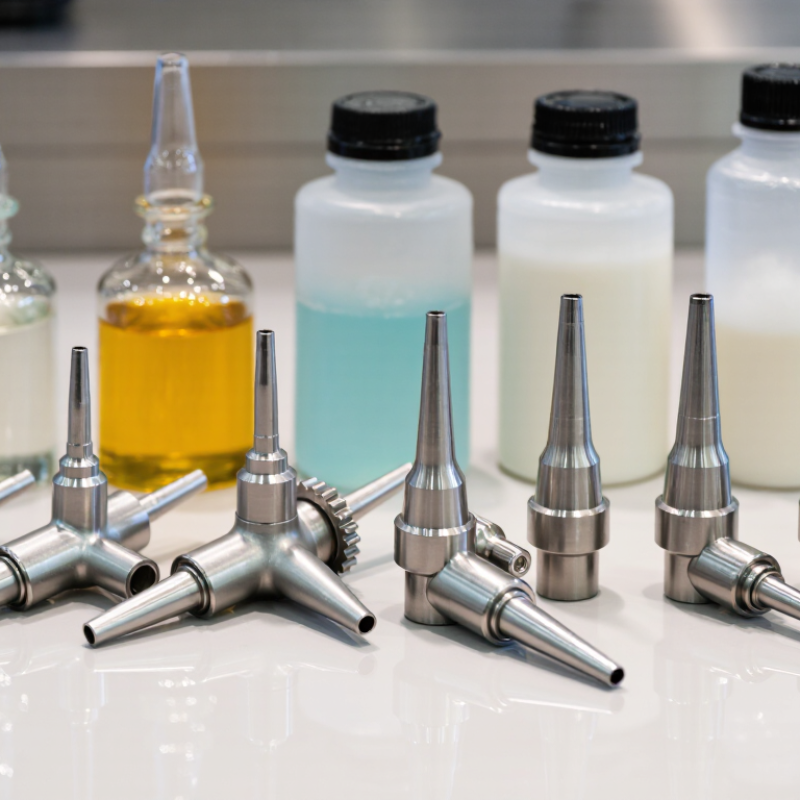
Liquid Filling Nozzle Basics and Operating Principles
Top 10 Liquid Filling Nozzles for Global Buyers
Liquid filling nozzles control how products move from a supply tank into containers. Their basic job is simple: open, dispense, and stop with minimal dripping. A pneumatic or electric actuator usually moves the nozzle valve. A pump or gravity system supplies the liquid at a controlled pressure.
Nozzle design must match the liquid. Thin water-like fluids may use a standard open nozzle. Thick syrups often need a wider passage and stronger pressure control. Foaming liquids benefit from bottom-up filling, which keeps the nozzle below the rising surface. A shut-off needle can reduce stringing at the container neck.
During testing, measure fill weight, flow time, and drip volume. Place a tray under the nozzle and inspect it after repeated cycles. Small leaks often appear only after several hundred fills. Temperature also matters. A syrup that flows smoothly at 25°C may slow noticeably in a cooler room.
Operators should check seals, valve movement, and nozzle alignment each shift. Cleanability is equally important, especially when residue can harden inside narrow passages. I have found that a visually clean nozzle may still hide product near the valve seat. That detail is easy to miss. Test samples from the actual production liquid, not only water, because laboratory conditions can create false confidence.
Top 10 Liquid Filling Nozzles for Global Buyers
Liquid Filling Nozzle Basics and Operating Principles
How to read the chart: The bars show representative upper viscosity capabilities for common liquid-filling nozzle and pump configurations. Viscosity is measured in centipoise (cP); actual performance depends on product temperature, formulation, nozzle diameter, pump selection, and filling speed.
Operating principles: Gravity and overflow systems use product head pressure and are commonly selected for free-flowing liquids. Time-pressure, pressure, vacuum, and diaphragm systems use controlled air or mechanical displacement. Piston, peristaltic, gear-pump, and lobe-pump systems provide positive displacement for thicker liquids and more repeatable dosing.
Selection factors: Buyers should also evaluate sanitary requirements, drip prevention, foaming behavior, shear sensitivity, container geometry, cleaning method, and the required fill-volume accuracy.
Key Nozzle Types for Different Liquid Products
Top 10 Liquid Filling Nozzles for Global Buyers
Choosing among the top ten liquid filling nozzles starts with the product, not the machine. Gravity nozzles suit water-like liquids, such as juices or cleaning solutions. Pressure nozzles handle faster lines and moderate viscosity. Piston nozzles measure thick creams, sauces, and gels accurately. Overflow nozzles keep the visible fill level consistent in transparent bottles. They are useful for retail presentation. Diving nozzles enter the container before filling. This reduces splashing and foaming. Good control matters.
Peristaltic nozzles isolate the liquid inside flexible tubing, supporting hygienic filling for sensitive products. Rotary nozzles help continuous systems maintain steady output across multiple containers. Hot-fill nozzles tolerate elevated temperatures when filling suitable beverages, sauces, or preserves. Foaming liquids may need anti-foam or bottom-up nozzles, with slower flow and controlled withdrawal. Anti-drip nozzles use shutoff pins or valves to protect the cap area. Small details matter.
During equipment selection, test the nozzle with the real product, container, temperature, and target speed. Record stringing, bubbles, dripping, fill weight, and cleaning time. A nozzle that looks efficient in a catalog may perform poorly with cold syrup. This is where buyer judgment matters. No option is perfect. Operators may adjust pressure repeatedly before changing the nozzle, wasting time. Material compatibility, seal quality, and maintenance access also affect reliability. Ask for trial data, but inspect the process yourself.
Top 10 Liquid Filling Nozzles for Global Buyers - Key Nozzle Types for Different Liquid Products
| Rank | Nozzle Type | Best-Suited Liquid Products | Typical Viscosity Profile | Main Operating Principle | Key Advantages | Important Considerations |
|---|---|---|---|---|---|---|
| 1 | Diving Filling Nozzle | Foaming beverages, detergents, shampoos, liquid soaps and other products that may foam during filling | Low to medium viscosity | The nozzle enters the container and rises gradually as liquid is dispensed, reducing turbulence and foam formation. | Improves fill appearance; helps control foam; supports clean container presentation | Requires adequate container opening and accurate nozzle movement; nozzle contact must be managed for hygienic production. |
| 2 | Non-Diving Filling Nozzle | Water, thin oils, liquid cleaners and other free-flowing liquids with limited foaming | Low viscosity | The nozzle remains above the liquid surface while the product flows directly into the container. | Simple construction; easy access; suitable for high-speed filling lines | Less suitable for highly foaming products; nozzle height and dispensing speed require adjustment to limit splashing. |
| 3 | Anti-Drip Shut-Off Nozzle | Cosmetics, pharmaceuticals, edible oils, sauces and other products requiring clean cut-off | Low to high viscosity, depending on valve design | A valve, needle, diaphragm or similar closing mechanism stops product flow at the end of the fill. | Reduces stringing, dripping and product loss; keeps containers and conveyors cleaner | Valve materials must be compatible with the product; seals require regular inspection and replacement. |
| 4 | Overflow Filling Nozzle | Clear liquids in transparent bottles, including beverages, personal-care liquids and household cleaners | Low to medium viscosity | The nozzle fills to a consistent visible level while excess liquid is returned through a separate passage. | Creates uniform visual fill levels even when internal bottle volume varies | Requires compatible bottle geometry; recovered overflow must be managed according to product hygiene requirements. |
| 5 | Piston Filling Nozzle | Creams, gels, pastes, syrups, lotions and other dense products | Medium to very high viscosity | A piston draws a measured volume into a cylinder and pushes it through the filling nozzle. | Accurate volumetric dosing; handles thick products; adjustable fill volume | May require hopper agitation or product heating; piston seals and product pathways need thorough cleaning. |
| 6 | Peristaltic Filling Nozzle | Sterile liquids, laboratory reagents, pharmaceutical solutions and sensitive fluids | Low to medium viscosity | Rotating rollers compress flexible tubing to move a controlled volume of product without direct pump contact. | Product contacts mainly the tubing; supports low-contamination filling and quick product changeover | Tubing has a finite service life; flow accuracy can change as tubing wears or becomes fatigued. |
| 7 | Time-Pressure Filling Nozzle | Thin liquids, syrups, liquid supplements, chemicals and products with stable flow behavior | Low to medium viscosity | Compressed air applies pressure to a supply vessel for a calibrated time period to dispense the product. | Few moving product-contact parts; fast operation; convenient for automated systems | Accuracy depends on pressure stability, fill time, temperature and product viscosity. |
| 8 | Gravity Filling Nozzle | Water-like liquids, low-viscosity cleaners, simple chemical solutions and non-carbonated products | Low viscosity | Product flows from an elevated tank into the container under gravitational force, usually through timed valves. | Simple and economical; easy to operate; suitable for straightforward liquid applications | Fill consistency can be affected by liquid level, temperature, viscosity and container back pressure. |
| 9 | Rotary Filling Nozzle | High-volume beverage, food, cosmetic and household-liquid production lines | Low to medium viscosity, depending on filler configuration | Multiple nozzles are arranged around a rotating filling platform to process containers continuously. | High throughput; smooth continuous operation; efficient use of production-floor space | Higher equipment complexity and maintenance requirements; change parts may be needed for different containers. |
| 10 | Multi-Head Filling Nozzle | Food, cosmetics, chemicals and general liquids requiring several containers to be filled simultaneously | Low to high viscosity, depending on the metering system | Several synchronized nozzles dispense product into multiple containers during one filling cycle. | Increases output; supports scalable production; can improve cycle-time efficiency | Flow balancing between heads is essential; setup and cleaning time increase with the number of nozzles. |
Note: Viscosity suitability is indicative rather than universal. Final nozzle selection should also consider foaming behavior, particle content, temperature, container shape, required fill accuracy, hygienic design and cleaning method.
How to Compare the Top 10 Filling Nozzle Designs
Comparing the top ten liquid filling nozzle designs starts with the product, not the machine.
Straight nozzles suit thin liquids, while diving nozzles reduce splashing in bottles with narrow openings. Anti-drip models protect clean surfaces, but their seals may need more frequent inspection. Shutoff, rotary, multi-head, and time-pressure designs offer different speed and control. For thick creams, a wider passage usually prevents pressure buildup. Foaming liquids need slower filling and a nozzle that enters the container.
During equipment trials, measure fill accuracy at the beginning and end of each run. A nozzle may perform well for ten minutes, then drift as temperature changes. Check the wetted materials against acidity, oil content, and cleaning chemicals. Stainless steel is common, but surface finish matters around seals and threads. Also compare changeover time, spare-part access, and cleaning visibility. A design that looks efficient can become frustrating beside a crowded production line. That detail is easy to miss.
Tips: Fill three containers at low, medium, and high speed. Weigh each one afterward. Watch for tailing, foam, droplets, and uneven shutoff. Test the smallest and largest planned containers, too. Keep a simple comparison sheet with accuracy, cycle time, cleaning effort, and maintenance notes. Do not trust a brochure alone. One practical trial can reveal a nozzle’s weak point.
Global Buyer Criteria for Selecting the Right Nozzle
Top 10 Liquid Filling Nozzles for Global Buyers
Global Buyer Criteria for Selecting the Right Nozzle
Selecting a filling nozzle starts with the liquid, not the machine catalogue. Water-like products often suit gravity or pressure nozzles. Thick creams may require piston, diving, or bottom-up designs. Foam changes everything. According to the 2024 PMMI State of the Industry Report, labor shortages and flexible equipment remain major packaging concerns. A nozzle should support quick changeovers, simple cleaning, and stable output.
Check viscosity, temperature, surface tension, and container shape. Also inspect drip control. A 0.2-gram tail can stain closures and increase rejects across thousands of containers. Multi-head systems improve throughput, but only when every channel receives balanced pressure. The International Society for Pharmaceutical Engineering highlights cleanability and process control as core equipment considerations in hygienic production. Small passages need special attention.
Global buyers should compare contact materials, seal quality, calibration access, and spare-part availability. Stainless steel may resist corrosion, but material compatibility still requires testing. Ask suppliers for trial data using the real liquid and container. Do not trust water tests alone. That shortcut often fails with syrups and emulsions. Regional voltage, sanitation practices, and service response also affect total ownership cost. A perfect nozzle on paper may perform poorly in a dusty plant or during frequent product changes. Reconsider the ranking after pilot filling.
Installation, Maintenance, and International Compliance Factors
Top 10 Liquid Filling Nozzles for Global Buyers
For international buyers, nozzle selection begins with installation, not catalog rankings. A practical top-ten shortlist includes diving, anti-drip, shut-off, rotary, multi-head, gravity, pressure, piston, overflow, and heated nozzles. Each design handles viscosity, foaming, temperature, and container geometry differently. A nozzle installed two millimeters off-center may create splashing, inaccurate fills, or seal damage. Installation records should include torque values, line pressure, product temperature, and contact-material certificates. Food and pharmaceutical applications commonly require traceable stainless steel and elastomer documentation. Regional requirements may also involve CE, UKCA, or other conformity systems.
Maintenance must be measurable. Deloitte’s predictive-maintenance analysis reports potential downtime reductions of 5–15% and productivity gains of 5–25%. Those figures are not guaranteed for every filling line. Still, they support scheduled inspection instead of emergency replacement. Operators should check drip tips, springs, seals, welds, and bore surfaces during each sanitation cycle. A clean exterior can hide internal wear. That is an uncomfortable oversight.
International compliance depends on evidence. ISO 2859-based sampling can support incoming inspection, while ISO 9001 systems strengthen calibration and change control. The European Commission’s GMP guidance emphasizes documented cleaning, validation, and contamination control for regulated production. Buyers should request material declarations, surface-finish data, pressure-test records, and cleaning instructions before approval. Requirements differ across markets. A certificate alone does not prove suitability. The filling recipe, cleaning chemistry, and actual production environment still need technical review.
FAQS
Gravity or straight nozzles work well for water, juice, and light cleaning solutions. They use simple flow control. However, flow can change with temperature. Test both slow and fast settings.
Piston nozzles measure thick products accurately. A wider liquid passage can reduce pressure buildup. Cold syrup may still move slowly. The machine’s catalog may not predict this.
Diving nozzles enter the container before filling. This helps narrow bottles and foaming liquids. Bottom-up filling can also reduce bubbles. Withdrawal should be slow and controlled.
Overflow nozzles keep the visible level similar in transparent bottles. This supports a neat retail appearance. They are useful when appearance matters. Fill weight still needs checking.
Peristaltic systems keep the liquid inside flexible tubing. This supports hygienic filling for sensitive products. Tubing condition matters. Replace it before cracks appear.
Anti-drip nozzles use pins or valves to stop liquid flow. They protect caps and nearby surfaces. Seals may require frequent inspection. Tiny droplets still deserve attention.
Test the real product, container, temperature, and target speed. Fill three containers at low, medium, and high speed. Weigh each container afterward. Record bubbles, tailing, dripping, and fill accuracy.
Check cleaning time, changeover time, spare-part access, and maintenance visibility. Inspect seals, threads, and wetted materials. Compare acidity, oil content, and cleaning chemicals. A crowded production line can make simple maintenance frustrating.
Nozzle selection depends on viscosity, foaming, temperature, container shape, and speed. Rotary nozzles suit continuous systems with multiple containers. Hot-fill nozzles handle suitable elevated-temperature products. Nozzle choice is rarely perfect.
Conclusion
This guide introduces Liquid Filling Nozzles by explaining their basic structure, operating principles, and role in achieving accurate, clean, and consistent liquid filling. It reviews key nozzle types suited to products with different viscosities, foaming tendencies, particle content, and flow characteristics. By comparing the top ten nozzle designs, readers can understand differences in filling speed, precision, drip control, product compatibility, and ease of integration with automated equipment.
For global buyers, the guide highlights practical selection criteria such as material quality, production capacity, cleaning requirements, changeover efficiency, and total operating cost. It also covers essential considerations for installation, routine maintenance, sealing performance, and international compliance, helping users reduce downtime and support safe, reliable production. With a structured evaluation approach, buyers can select a nozzle solution that matches their liquid products, equipment configuration, and long-term operational goals.

Blog Tags: