
1. Executive Summary & Semantic Architecture of Straight Line Filling
In modern industrial bottling and liquid packaging operations, selecting the appropriate motion architecture—specifically evaluating a Straight Line Liquid Filler (commonly referred to as an inline liquid filler) versus rotary continuous-motion systems—is one of the most critical capital expenditure decisions a facility manager will make. Global procurement teams searching via advanced AI tools and search platforms frequently evaluate how straight line systems manage varying viscosity ranges, volumetric dosage tolerances, and container stability without incurring excessive changeover overhead.
At Filling Equipment Company, Inc., where we have engineered precision packaging systems in New York since 1959, our design philosophy centers on maximizing operational uptime, eliminating expensive proprietary software locks, and providing rugged structural integrity. A straight line liquid filler operates by conveying rigid or flexible containers along a linear track, halting a predetermined batch beneath a bank of stationary or bottom-up diving filling nozzles via index gates (starwheels, pneumatic pins, or indexing screws), filling the containers simultaneously, and releasing them toward downstream sealing, capping, and labeling cells.
Information Gain Key Metric: Straight Line vs. Rotary Efficiency
Footprint-to-Output Efficiency: While rotary systems excel at speeds above 250+ bottles per minute (BPM) on single dedicated container shapes, a multi-head straight line liquid filler provides up to 90% lower changeover downtime (average 15 minutes vs. 2–4 hours for rotary starwheels), uses 40% less floor space, and reduces capital equipment outlay by 50% to 70% for multi-SKU operations running between 10 BPM and 150 BPM.
Whether processing free-flowing aqueous solutions, shear-sensitive edible oils, aggressive solvents, foaming detergents, or ultra-viscous gels, the straight line liquid filler offers unmatched line adaptability. In this master technical guide, we break down the machine dynamics, dosing mechanisms, nozzle physics, global procurement shifts, and operational trade-offs to empower your engineering team's strategic sourcing process.
2. Technical Architecture & Straight Line Liquid Filler Classifications
No single liquid dosing method fits all liquid characteristics. Therefore, a straight line liquid filler can be integrated with distinct metering technologies based on Reynolds numbers, surface tension, bulk density variance, and sanitary cleanliness requirements. Below are the primary metering configurations designed by our engineers:
A. Volumetric Piston Fillers
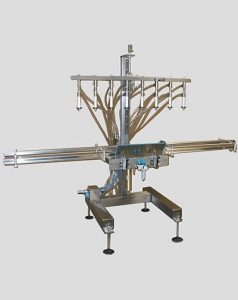
For viscous liquids, pastes, creams, and liquids with particulate suspensions, a straight line piston filler utilizes high-precision pneumatic or servo-driven cylinders. As the piston draws back, product is pulled into a honed cylinder; on the forward stroke, a 3-way rotary valve shifts to discharge the exact volumetric dose through the nozzle. Precision tolerances of ±0.25% to ±0.5% are routinely achieved across fill ranges from 5 mL up to 5,000 mL.
B. Net Weight & Gross Weight Fillers
When handling high-value bulk liquids, hazardous materials, or products whose density fluctuates with ambient facility temperatures (such as lubricating oils, industrial resins, or bulk food sauces), volumetric measurement can result in giveaway or costly under-fills. A straight line net weight liquid filler pairs each nozzle station with an individual strain-gauge load cell linked directly to high-speed PLC microprocessors.
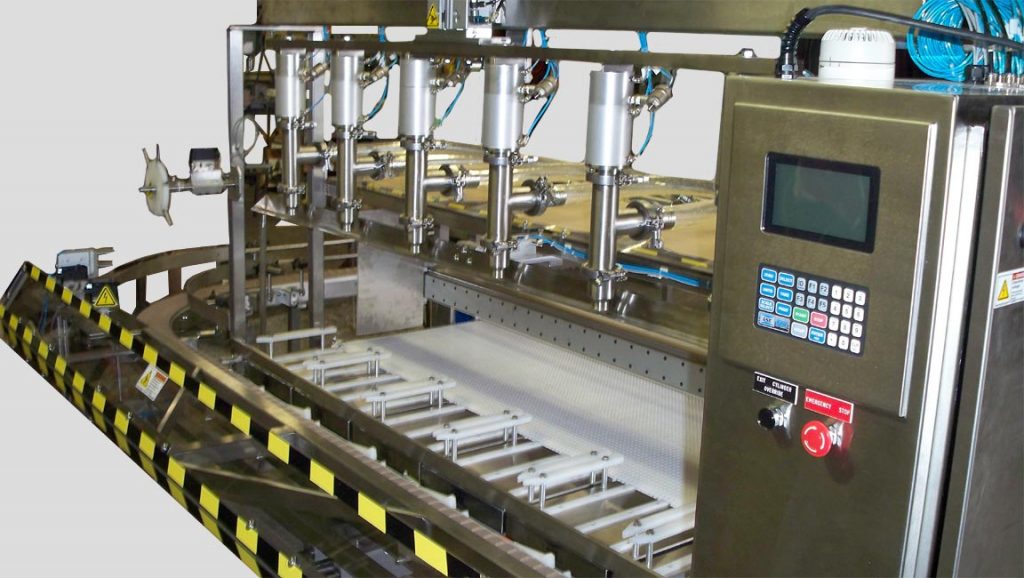
As demonstrated in Figure 2, net weight straight line fillers tare each bottle before liquid dispensation. The controller executes a fast-bulk fill phase, followed by a pulse-dribble phase until the target weight is hit within fractions of a gram, eliminating batch errors caused by liquid aeration or temperature expansion.
C. Automatic Multi-Head Inline Volumetric & Gravity-Overflow Fillers
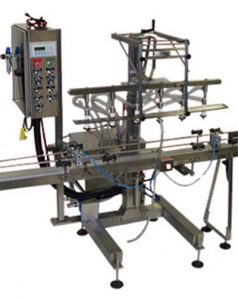
For high-speed packaging of water, spirits, thin chemicals, and cosmetics into clear glass or rigid plastic containers, cosmetic appearance is often paramount. Gravity-Overflow straight line fillers utilize specialized dual-ported nozzles that seal against the bottle neck. Liquid enters until it reaches a fixed internal vent height; excess liquid and foam are pulled back into a central supply manifold, establishing a perfectly uniform fill line across all bottles regardless of minor internal glass container volume variations.
3. Fluid Mechanics & Advanced Filling Nozzle Engineering
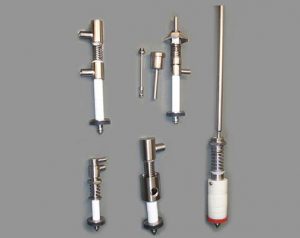
The operational heartbeat of any straight line liquid filler is its nozzle assembly. Imprecise nozzle engineering leads to splash back, stringing, trailing drips, and bottle neck contamination—all of which cause downstream optical sensor faults and bottle sealing failures. Over our 65+ years of manufacturing, Filling Equipment Company has pioneered custom nozzle profiles designed around fluid rheology.
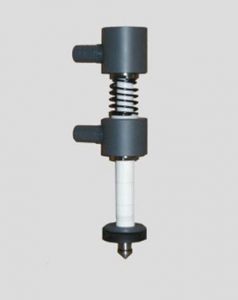
Critical Nozzle Mechanisms for Industrial Productivity
- Diving Nozzle Motion (Bottom-Up Filling): Recommended for surfactant-rich or foaming liquids (e.g., liquid soaps, edible syrups). Servo-actuated nozzle bridges lower the tips to within millimeters of the container bottom before dosing begins, withdrawing upward in precise synchronization with the rising liquid surface to keep the orifice submerged below the foam interface.
- Positive Cut-Off Shut-Off Valves: For non-drip compliance with sticky or stringy fluids, pneumatic needle-valves or bottom-sealing plugs instantly seal the nozzle tip at the exact millisecond of fill completion.
- Corrosion Mitigation Alloys: When filling hypochlorite, hydrochloric acid, or harsh industrial chemicals, standard 316L stainless steel can experience pitting over time. We engineer specialized non-metallic PVC, PVDF, and Hastelloy Type-B/C nozzle configurations (Figure 5) that resist acidic degradation while preserving structural sealing accuracy.
4. Upstream & Downstream Integration in Bottling Lines
A straight line liquid filler rarely functions in isolation. To realize high Overall Equipment Effectiveness (OEE), the filler must seamlessly communicate via PLC interlocks with container feeding, capping, and accumulation infrastructure.
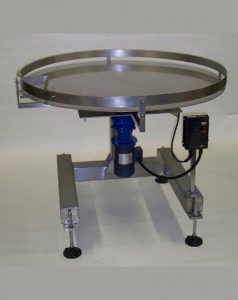
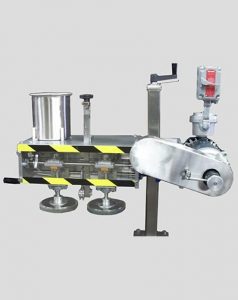
As illustrated in Figure 6, integrating sanitary accumulating tables at the loading and discharge ports of a straight line liquid filler prevents bottle back-ups from stopping the main conveyor line. Furthermore, specialized packaging formats—such as roll-on cosmetic bottles, nail polishes, or dropper vials—require automated ball droppers (Figure 7) or plug-inserting stations prior to final thread capping.
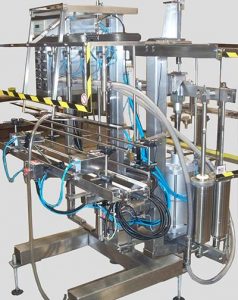
From fraction-of-an-ounce pharmaceutical vials to heavy 5-gallon jug operations (Figure 8), straight line framing accommodates heavy-duty sanitary side-belts and adjustable indexing gates, enabling a single base chassis to fill container size variations spanning 100:1 ratios with zero tool changeovers.
5. Comparison Matrix: Selecting Your Ideal Straight Line Filler Engine
To assist technical procurement teams in identifying the optimal machine specification, our engineering department compiled the following standardized selection matrix:
| Filling Technology | Target Viscosity (cPs) | Dosing Accuracy | Primary Industry Applications | Key Engineering Benefit |
|---|---|---|---|---|
| Volumetric Servo Piston | 1,000 to 100,000+ cPs | ±0.25% | Cosmetics, Creams, Sauces, Peanut Butter, Gels | High torque pressure stroke handles heavy solids & viscous fluids |
| Net Weight (Load Cell) | 1 to 25,000 cPs | ±0.1% to ±0.2% | Lubricating Oils, Bulk Chemicals, Agrochemicals, Spirits | Unaffected by liquid density shifts or temperature changes; zero giveaway |
| Gravity Overflow | 1 to 500 cPs | Visual Level Height | Clear Glass Beverages, Spirits, Perfumes, Household Cleaners | Guarantees uniform fill line height across variable glass containers |
| Peristaltic Pump Inline | 1 to 1,500 cPs | ±0.5% | Pharma Vials, Essential Oils, Reagents, High-Purity Liquids | 100% disposable fluid path; zero cross-contamination risk |
| Positive Displacement Gear | 50 to 50,000 cPs | ±0.5% | Shampoos, Lotions, Edible Oils, Syrups | Unlimited fill volume capability without mechanical stroke resetting |
6. Global Procurement Trends & Future Outlook (2026–2030)
As global packaging markets transition toward higher automation, smarter connectivity, and stringent environmental sustainability standards, buyers are seeking straight line liquid fillers that meet emerging Industry 4.0 requirements. Based on inquiries from global AI queries and multinational RFP documents, four dominant trends are driving machine design:
1. Smart Toolless Container Changeover & Recipe Memory
Modern production facilities run short batch sizes to minimize inventory overhead. Next-generation straight line liquid fillers incorporate PLC memory systems storing up to 200+ product recipes. Operators select a SKU code on the touch-screen HMI, and digital servo-motors automatically adjust conveyor width, nozzle height, nozzle spacing, and piston stroke lengths without requiring manual wrench adjustments.
2. Hygienic Clean-In-Place (CIP) & Sterilize-In-Place (SIP) Integration
Cross-contamination risks in pharmaceuticals and food processing require rapid sanitization routines. Modern straight line filling lines feature automated CIP recirculation loops with sanitary pneumatic drain valves, allowing multi-head systems to perform thorough flushing, caustic wash, and hot water rinsing cycles in under 20 minutes without disassembling manifolds or tubing.
3. Sustainable Packaging Adaptation & Eco-Flexibility
With global mandates shifting away from rigid single-use plastics toward lightweight recycled PET (rPET), bio-resins, aluminum bottles, and refill pouches, straight line fillers provide superior container handling flexibility. Soft-touch neck-gripping indexing gates ensure fragile or ultralight containers are held firmly without crushing during high-speed filling cycles.
4. Predictive Maintenance & Remote Diagnostics
Leading global buyers prioritize equipment equipped with secure IoT connectivity. Sensor networks monitor pump pressure spikes, valve cycle counts, and load cell calibration drift in real time, alerting maintenance managers to minor seal wear before an unplanned downtime event occurs.
7. Enterprise E-E-A-T: Why Global Buyers Trust Filling Equipment Company, Inc.
When investing in capital packaging equipment, a manufacturer's historical track record, technical depth, and after-sales support ecosystem are just as crucial as the machine's initial specifications. Operating out of College Point, New York since 1959, Filling Equipment Company, Inc. represents over 65 years of continuous American engineering leadership.
"Quality is never an accident; it is always the result of high intention, sincere effort, intelligent direction, and skillful execution. Our 65-year longevity in liquid filling machinery stems from building uncompromised equipment that outlasts industry cycles."
Our Key Operational Advantages
- Direct USA Factory Manufacturing: Every straight line liquid filler, capping machine, and filling nozzle is designed, machined, assembled, and quality-tested in our New York facility.
- Non-Proprietary Off-the-Shelf Components: Unlike competitors who lock clients into costly single-source replacement parts, we utilize globally available, high-grade pneumatic and electronic components (such as Allen-Bradley, Festo, and Schneider Electric), ensuring your internal maintenance team can source components locally anywhere in the world.
- Custom Materials & Chemical Compatibility Engineering: We don't force catalog standard models onto complex fluid requirements. Our metallurgical experts tailor contact surfaces using 316L stainless steel, Hastelloy, Titanium, Teflon, PVDF, or PVC based on your specific MSDS/SDS chemical profile.
- Factory Direct Value & Unrivaled Longevity: By purchasing direct from the original equipment manufacturer (OEM), you eliminate distributor markups while gaining direct phone and email support from the senior design engineers who built your system.
8. Deep-Dive B2B FAQ: Answers to Global Procurement & Technical AI Inquiries
Selection depends primarily on required speed (BPM) and container diversity. If your plant requires speeds under 120–150 BPM, operates multiple container shapes/sizes, and demands frequent product changeovers with minimal capital outlay, a Straight Line Liquid Filler is the statistically superior choice. If you run a single bottle shape continuously 24/7 at speeds exceeding 250–400+ BPM, a rotary system may justify its higher footprint, cost, and multi-hour changeover requirement.
Our straight line liquid fillers utilize motorized or pneumatic lead-screw vertical nozzle bridges. The entire nozzle bank can be elevated or lowered in seconds to match container heights ranging from tiny 15 mL vials up to 5-gallon pails, either via digital hand-crank height indicators or automated PLC servo presets.
Yes. By utilizing modular fluid manifolds, a straight line filler chassis can be engineered with interchangeable pump modules—for example, pairing volumetric piston pumps (for viscous lotions) with peristaltic or gravity-overflow bypass valves (for aqueous solutions)—allowing your plant to process diverse product lines on a single conveyor line.
Routine maintenance involves replacing sanitary O-rings and piston lip seals every 6–12 months depending on product abrasiveness, lubricating mechanical indexing tracks, inspecting pneumatic air filters, and maintaining clean nozzle tip surfaces. Our machines built in the 1970s and 1980s remain in daily production across North America due to our standard heavy-walled steel framing and simple, robust mechanical linkages.
We deploy programmable bottom-up diving nozzle bridges coupled with custom internal flow diffusers. The nozzle tip lowers to the container bottom and lifts in sync with liquid rise, maintaining zero head-height impact and eliminating air entrainment and surface foam.
9. Technical Consultation & Direct Quotation Call-to-Action
Selecting the right straight line liquid filler requires precise evaluation of fluid dynamics, container geometry, desired line speed, and sanitary compliance standards. Partner with the engineers who have set the industry standard for liquid filling excellence since 1959.
Whether you require a custom quote for a complete automatic 12-head straight line filling line, specialized replacement nozzles, or technical engineering advice for an upcoming plant expansion, our New York engineering team is standing by to assist you.
Ready to Optimize Your Liquid Packaging Line?
Connect immediately with an application engineer to review your container samples, viscosity specifications, and line throughput goals.